Phoenix Adopted Hemp-Lime Building Codes in 2025 and Almost No One Noticed
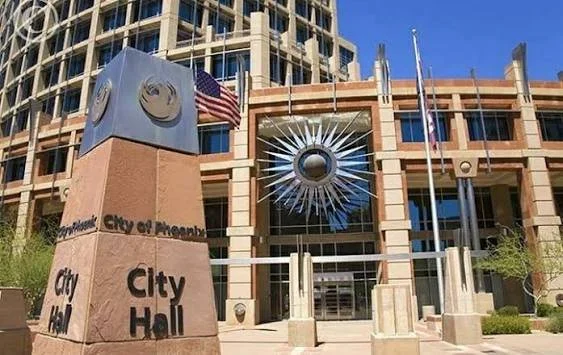
Photo courtesy City of Phoenix

By Jean Lotus
In June 2025, the City of Phoenix, AZ adopted the 2024 International Residential Code (IRC) along with a handful of natural-building appendices, including Appendix BL, Hemp Lime (Hempcrete) Construction. The new code took effect August 1, 2025. But as far as anyone in the hemp building industry can tell, it went largely unreported.
Hemp-lime is new to the US residential building codes, approved for the first time as Appendix BL into the 2024 IRC. Appendices to the US residential codes are optional and require specific adoption by a jurisdiction.
Phoenix wasn't the first city to adopt hemp-lime into the US model residential building codes. The City of Austin, TX, was the first, effective that same July. Other jurisdictions en route to adopting hemp-lime in their building codes via Appendix BL include the state of Minnesota and Commonwealth of Virginia.
But Phoenix, one of the fastest-growing cities in the country, adopted hemp-lime with zero fanfare. Because Arizona has no statewide building code and operates under a home-rule system, building code decisions fall to each city, town, or county. Maricopa County has not yet adopted Appendix BL.


Large Commercial Project Blazes a Trail in Tucson
Meanwhile, 115 miles south in Tucson, AZ one of the largest commercial hempcrete projects built in the U.S. to date was completed that same summer.
Micaela Machado, a licensed Arizona contractor and co-owner of Old Pueblo Hemp Company, led a team that hand-made more than 16,000 hemp-lime blocks to insulate six existing cabins at the Cooper Center for Environmental Learnings, a longtime Tucson institution used by generations of local school kids who call it “Camp Cooper.” Old Pueblo Hemp, a family-owned business, partnered with the University of Arizona's architecture program, commercial architecture firm Swaim Associates, and general contractor CHASSE Building Team.
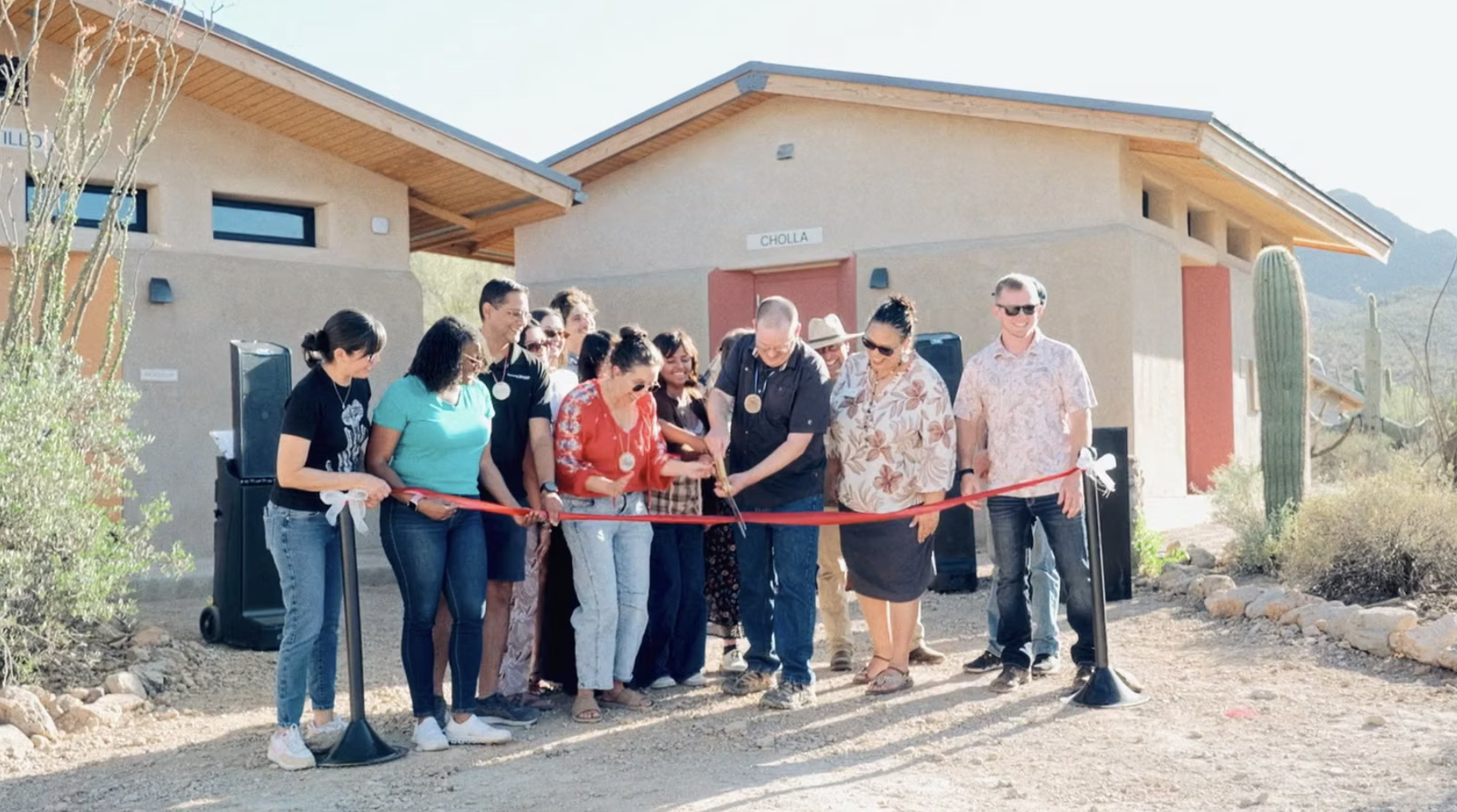
Ribbon-cutting at Cooper Center for Environmental Learnings in front of residential cabins insulated with hemp-lime and plaster. Photo courtesy of CHASSE Building Team
Machado: "That's What Makes a House Affordable"
For Machado, the case for hemp-lime in a desert climate comes down to high-performance. "It's about energy efficiency, especially out here in this desert heat," Machado told HempBuild Mag. "Building with materials that are far superior, way higher-performing, can reduce our energy costs."
Machado pushed back on equating cheap construction with affordability: "Energy-efficient housing is actually what affordable housing is. Affordable housing cannot mean cheap-to-build housing, because that's not affordable — for the cost of the environment, the cost of your health, the cost to your pockets for the energy costs."
Machado said she’s seen energy efficiency play out Camp Cooper directly. "You walk into the cabins and it's a cool 75 degrees," she said. "They're extremely, extremely comfortable, and they're hardly outputting any energy for that."
Join our FREE online community here


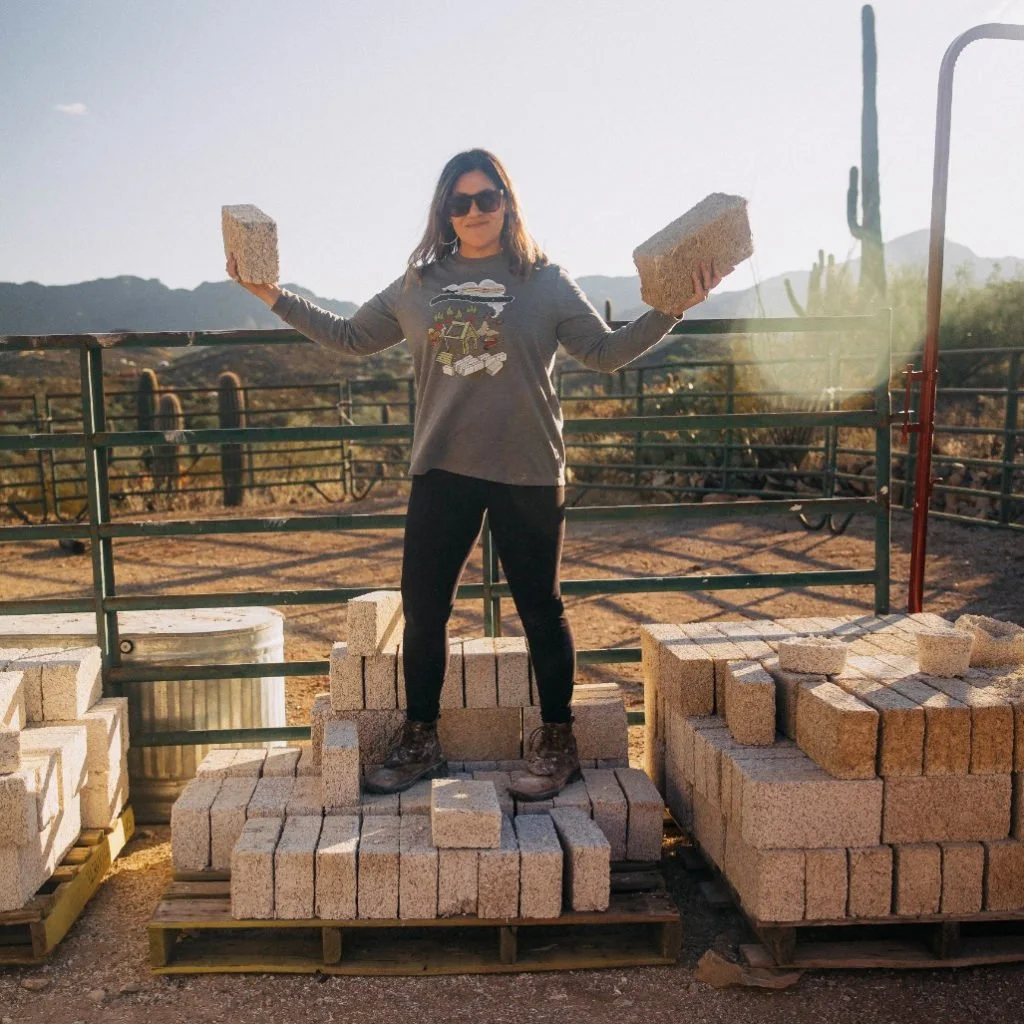
Micaela Machado, co-owner of Old Pueblo Hemp Company poses with her hand-made hempcrete blocks in her Tucson factory. Photo courtesy of Micaela Machado
"Easier Than Using CMU"
Dakota Snyder, a general contractor with CHASSE Building Team, believes no one has broken ground on a hempcrete project inside Phoenix city limits yet. Even working with hemp-lime in Arizona is a novelty, he said. "As far as I know, we're really the first to do it," he told HempBuild Mag. Snyder called Tucson a “green city.”
Snyder's crews worked with hempcrete on the job and came away impressed. "It was a really easy product to work with — basically easier than even using something like CMU, because it's lightweight and it cuts easier," he said, noting the blocks weigh roughly 40 percent of a standard concrete masonry unit. "Durability is great. The insulation value of it is great. Overall, super happy with how the whole project went."

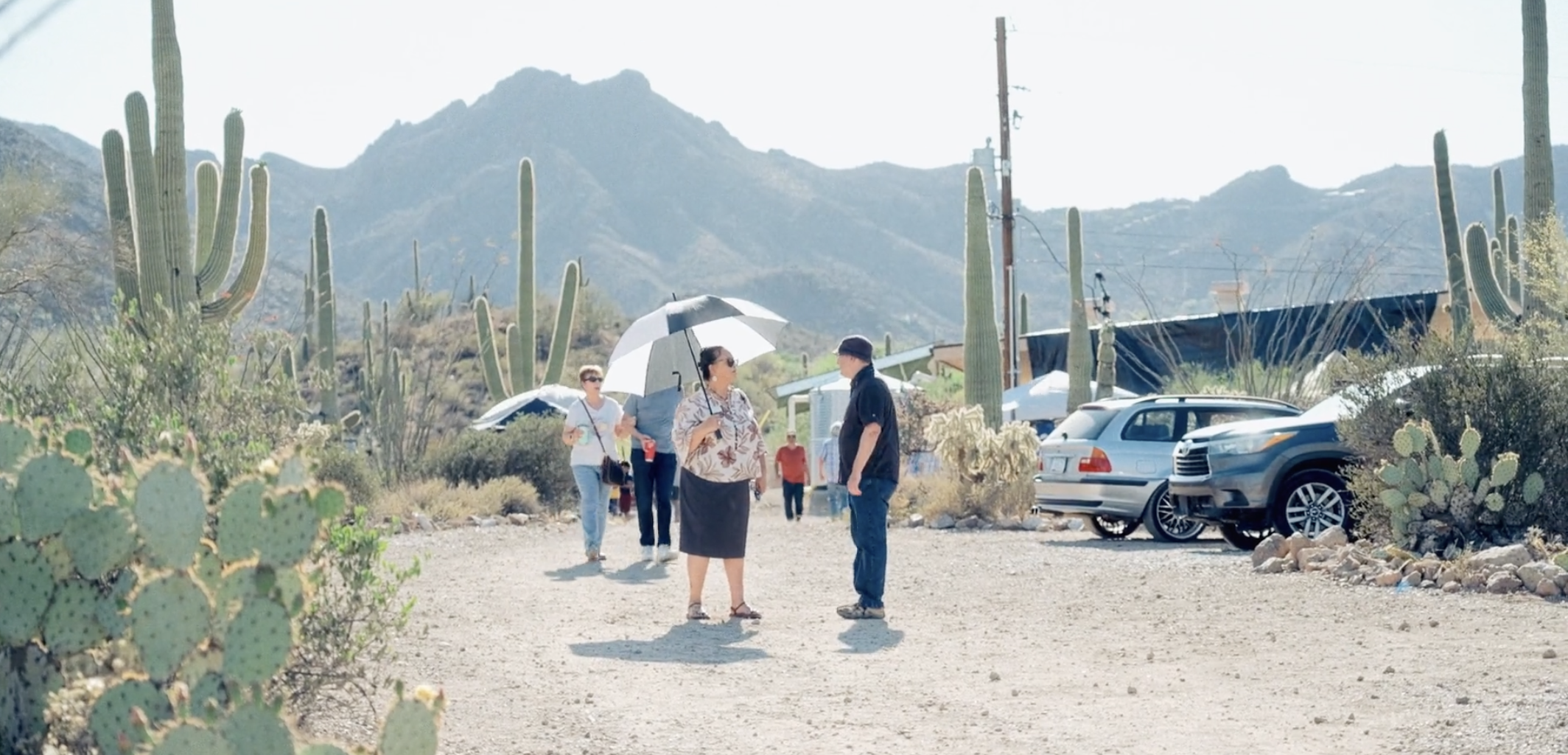
New renovations at Camp Cooper opened to the public on Earth Day (April 22, 2026). Photo courtesy CHASSE Building Team
"The Natural Ones Were Lower"
Valerie Rauh, an architectural designer at Swaim Associates who drafted the Camp Cooper project, said the design team spent significant time upfront comparing insulation options and running embodied-carbon calculations modeled with the BEAM Estimator carbon-accounting tool from Builders for Climate Action.
"We did a baseline with no insulation, and then a more conventional construction with more toxic materials, like an EIFS with polystyrene, and that was our benchmark," Rauh told HempBuild Magazine.
The team ran calculations for Gutex & steel, denim insulation, strawbale and plaster and HempWool with metal siding. The data gave them the clear answer, Rauh said, and they chose hemp-lime.
She acknowledged some early hesitation at her office on a first-of-its-kind build — "we'd never detailed [hempcrete] before" — but said the extensive pre-design process helped get the entire project team “on the same page."
Check Out Our FREE International Hemp Construction Suppliers Map


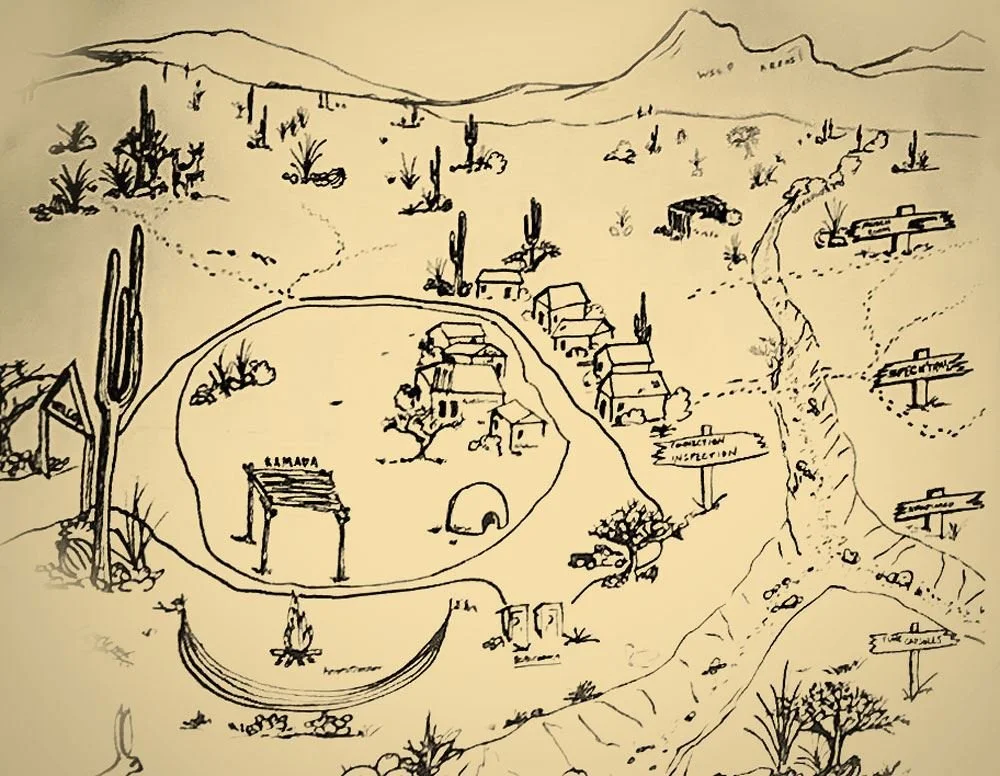
“Camp Cooper” first opened in the 1960s as an outdoor learning center for students of Tucson Unified School District. Photo courtesy University of Arizona
The University of Arizona is now monitoring the cabins for air quality as part of an ongoing research partnership, though Rauh said it's too early for hard performance data. Anecdotally, "you can definitely feel a difference walking inside and out" compared to the cabins' original uninsulated CMU walls, Rauh said.
Asked whether hempcrete could scale beyond demonstration projects, Rauh was optimistic but realistic: Hempcrete can be feasible commercially, she said, but "maybe not in the application that we used" — hand-laid block — "a bit more like a formwork sheet or panel," to bring labor costs down. Cost, she said flatly, "has to drive everything, unfortunately."

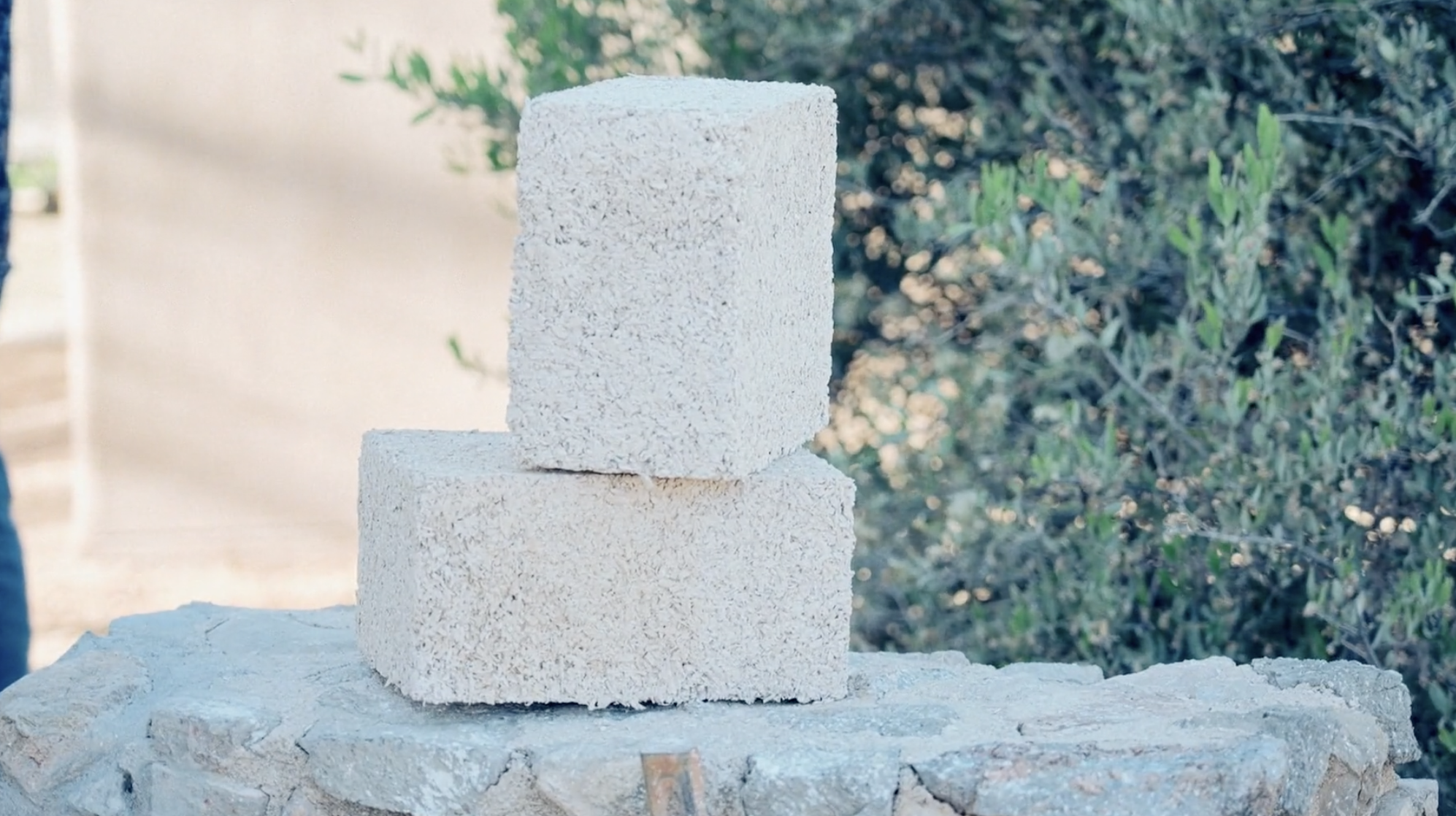
Hempcrete blocks on display at Camp Cooper. Photo courtesy CHASSE Building Team
Back to Phoenix
It’s not mandatory in the United States for building methods or materials to be included in a jurisdiction’s building codes. A project with innovative materials or methods can apply for approval under an “alternate pathway.” But adoption into a local building code helps cut red tape for permitting and inspections, builders say.
“It’s great that the city of Phoenix adopted all of these natural building codes,” David Eisenberg, founder of Tucson environmental non-profit Development Center for Appropriate Technology told HempBuild Magazine. Eisenberg and a team including Berkeley, CA architect Martin Hammer and engineer Anthony Dente have co-authored most of the International Code Council’s IRC natural building codes for more than 30 years. “Phoenix is setting a nice example for other jurisdictions in the state,” Eisenberg added.
The city of Tucson has not adopted Appendix BL, and its residential building code only comes up for amendment every six years. The city did recently adopt Appendices BB (Tiny Houses) BI (Light Straw Clay), BJ (Straw Bale Construction) and BK, (Cob Construction), giving natural-building advocates a toehold with the city’s Planning and Development Services Department.
Machado and her collaborators believe Camp Cooper, a permitted, occupied, publicly visible commercial project built with a state university, gives hemp-lime new weight next time building code adoption comes up in Tucson.
“If they’re adopting building codes in Phoenix, that eventually trickles along down the line for [Tucson],” said architect Rauh.


A Future for Hempcrete Blocks in Phoenix
Meanwhile, Quadra Concrete located its US headquarters in Phoenix in 2017 as one of the fastest growing cities in the United States. The international French company manufactures robotics and specialty machines for cementicius block factories. Quadra provided robots and machinery for the updated IsoHemp factory in Fernelmont, Belgium, which pumps out 5 million hempcrete blocks yearly from its expanded 2-hectare factory.
Quadra has worked with bio-based block manufacturers to create special equipment including a vibration and rammer system “in order to compact the hemp homogeneously and precisely over the entire height of the product,” the company says.
When Old Pueblo Hemp is ready to upgrade to a state-of-the-art factory, Quadra is nearby.
Phoenix Offers Hempcrete Opportunities
The Big Saguaro has seen its share of straw bale homes and has a long history of adobe and rammed-earth homes, but you’ll have trouble finding a hempcrete project built in the city. Still, hempcrete know-how is just down the road for developers and builders who want to take advantage of the construction expertise from Tucson’s Camp Cooper.
“We’re not that far away,” said Tucson architect Rauh. “So [builders in Phoenix] can always give us a call,” she added.


Please Support Our Classified Advertisers
(To find out more about advertising CLICK HERE).
Publications
NOW AVAILBLE! Hemp Building Directory 2026 - Guide to the International Hemp Building Industry
Hempsteads: Architectural details for hemp-lime construction, by Timothy Callahan
Architects/Design Pros/Engineers
Next Genesis Design brings natural materials into high-performance building systems and healthy homes. White Salmon, WA
Bio-based Engineering and Design at Crownjade Design & Engineering, Greeley, CO
Experienced Natural Building Engineering Services from Verdant Structural Engineers, CA
Green Builders
Naturalia Construction, Colorado-based Sustainable Construction with Hemp
Design and build your hempcrete home in Colorado’s front range with Healthy Hemp Homes
Aaron Grail Construction, No. Cal: The intersection of art, design and performance
Evolve Construction: Providing healthy, sustainable, housing for future generations. Northern CO
Hemp Building Research and Training
Hemp Build School online and IRL for Homeowners and Professionals
Follow the Hemp Casita from Right Coast Hemp to learn more about building with hemp.
Hemp Hurd (shivs)/Hemp Fiber/ Hemp Microfiber
CannaVision, Fort Worth, TX: Home of the Pulsewave Hemp Processor
Riverdale Hemp Gin producing hemp raw materials in the Central Valley (CA)
IND HEMP: Supporting Farm Families and Rural Communities with Natural Materials Processing
E3 Agriculture: Texas plant-based materials for construction, industry, and agriculture.
East Coast Hemp Supply: Your source for hemp building materials in NC
Prairie Band Ag. Hemp Hurd Cultivating a future rooted in nature. Holton KS
Hempcrete installers/Insulation subcontractors
Americhanvre Cast Hemp: Supplies, Equipment, Experienced Hempcrete Installation
Hemp Build Network: We Make Building with Hemp Possible, New Braunfels, TX
Hemp Building Company: Hempcrete installation, supplies Lafayette, CO
Victura Hemp: Spray-applied hemp installation in New England
Hemp Batt Insulation/Supplies
Lime Binders, Plasters and Mineral Paints
US Heritage Group: Experienced Hemp Building Binder Suppliers
Hemp and Block, LLC- Hempcrete Binder
Earthaus specialty lime plasters for the health & beauty of authentic mineral finishes
Silacote Environmentally Safe Inorganic Paints (CA and Canada)
Magic Minerals hemp-lime catalyst: Proven success. Made in USA
Machine Manufacturing Companies
Quadra Concrete robotics and specialty machines in France and Phoenix, AZ USA
Hemp Wall Panel Products
Preorder your hempcrete tiny house from Sativa Building Systems
Panel solutions from Homeland Hempcrete
Hemp Hardwood and Flooring:
Hemp Blocks