Zac Efron’s Hempcrete House Begins Construction in Australia
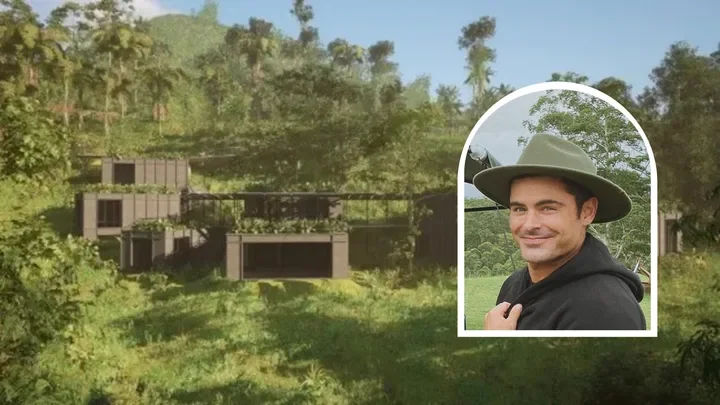
Hollywood star Zac Efron is building a $2.25 million hempcrete home in an Australian rainforest. Photo courtesy of Zac Efron’s Instagram account.

By Jean Lotus
An Australian webinar with Dutch-Australian designer Joost Bakker unveiled details of Hollywood actor Zac Efron’s new $2.25 million hempcrete home being built this year in a tropical forest in New South Wales.
Called “Futurecave,” the home consists of connected bio-construction pods to be built on 128 hectares of rainforest property in the muggy mountainous hills of Tweed Shire, near Byron Bay, NSW. The April 23 webinar was hosted by iHemp NSW.
Bakker said he met Zac Efron in 2021.
"When he asked me to design his house, he said, can you use as much hemp as possible," Bakker recalled.



Mold Resistance in the Tropics
Efron's own health history shaped materials selection, Bakker said. The actor suffered mold poisoning and become seriously ill from it. In a high-rainfall subtropical location, that meant moisture management was not optional — it was the starting point.
All the Futurecave pods are elevated off the ground. Louvres are positioned for cross-ventilation. Materials were chosen specifically for their ability to absorb and release moisture rather than trap it. Bakker admitted he was critical of highly airtight passive-house systems for precisely this reason, and the Efron house is built to breathe.
"I actually think a home is like a human being," he said. "If I put wet weather gear on and it doesn't breathe, I start to sweat. A house is no different. And the beauty about working with hemp … [it] can absorb water, but they can release it as well."
On mold specifically, Bakker was unequivocal. "If you're worried about mold, you can't really beat hempcrete or these hemp blocks. It's impossible. They cannot grow on this."
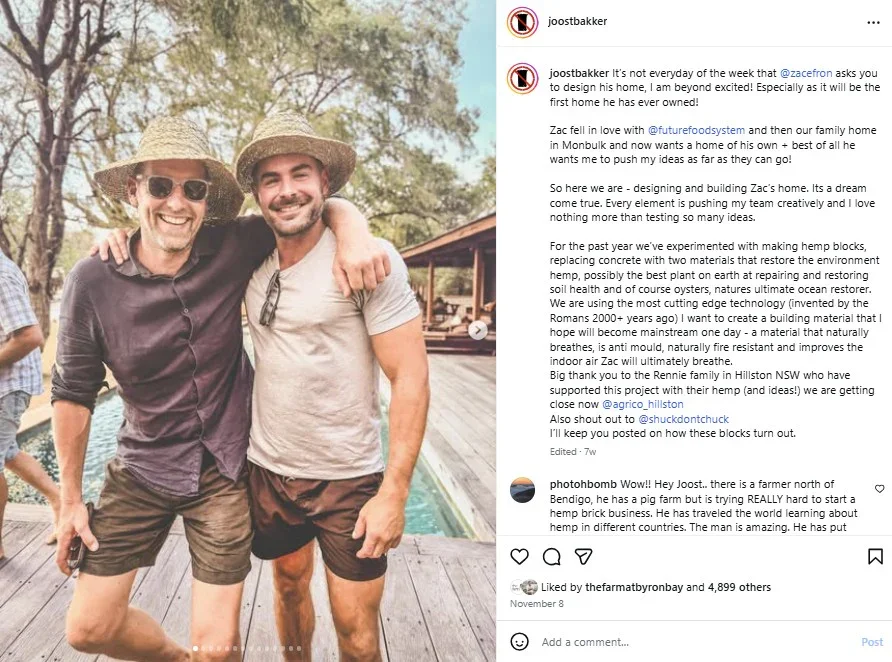
Sustainability designer Joost Bakker (L) poses with Hollywood star Zac Efron(R). Photo courtesy Joost Baker’s Instagram


Ideas Guy
Joost Bakker is not an architect or a traditional builder; he describes himself as "just a guy with ideas." Yet, his ideas have generated interest in Australian sustainability over the last two decades. Born in the Netherlands and migrating to Australia in 1982, Bakker’s journey began on his family’s farm in the Dandenong Ranges. It was here that he first witnessed the destructive power of industrial agriculture—specifically the use of methyl bromide to "drop a nuclear bomb" on soil-borne diseases—and the contrasting restorative power of hemp.
After building a name for himself in the 1990s through art and zero-waste installations, Bakker transitioned into the built environment. He gained international acclaim for his pop-up "Greenhouse" restaurants and the "Future Food System" project at Melbourne’s Federation Square, a house designed to feed two people entirely from food grown on its 100-square-meter footprint.


The Full Material Palette
The Efron house sits near Brunswick Heads in the Tweed Shire. It is entirely off-grid — eight kilometres from the nearest power connection, receiving three and a half metres of rainfall a year.
The external finish on the Efron house is a 100% natural cork spray by Diasen manufactured in Italy from wine-cork waste. It is breathable, fire-tested, and provides a rendered appearance, Bakker said. Roof insulation is New Zealand wool.
Flooring is recycled-brick tile from Melbourne embedded with stripped copper wire grounded to the earth. “Zac loves to walk barefoot,” Bakker confided. Bakker has used it on several buildings to keep occupants connected to the earth's magnetic field, he said.
Plumbing uses copper for water lines and recyclable polyethylene rather than PVC. Joinery will be roduced using a plant-based circular resin from Dutch company Plantics.
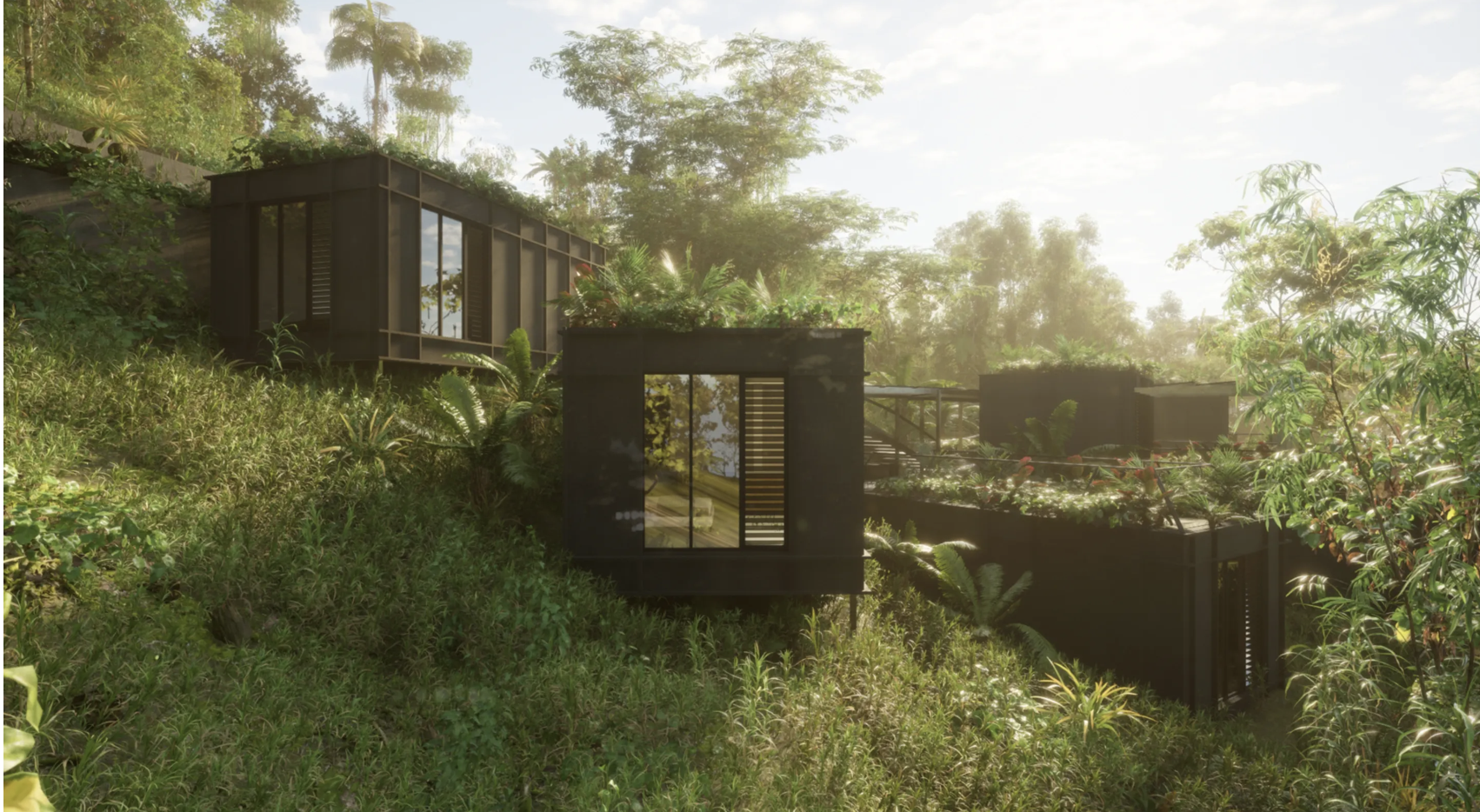
A rendering of Efron’s planned new hempcrete dwelling, a series of interconnected healthy pods. Photo courtesy Instagram

The solar array is made up of tested and tagged second-hand panels sourced through Lotus Energy in Melbourne, which runs a recycling program for end-of-life solar equipment. Some panels, Bakker argues, have another two decades of useful life. "Some of them will definitely last another 20, 25 years, so why would we use new?"
Wastewater goes to a worm farm. Efron wants to grow his own food, so the property includes stone fruit, Kakadu plum, and other crops.
Hemp blocks made with an oyster-shell binder — developed with the Shuck Don't Chuck program as a potential replacement for mined lime — are being used for the internal walls, with testing ongoing.
"I love that idea that the hemp has restored the soil, and the oysters have restored the reef," Bakker said. "So from that perspective, I think it is an incredibly sustainable way to build."

Hemp Appliances Partnership with Miele
The team is working with the German appliance giant Miele to develop hemp-based home appliances, including a washing machine and dryer. This partnership aims to replace traditional plastics and steel with biodegradable hemp-based alternatives.Bakker is also exploring the use of circular, plant-based resins from companies like Plantics to create genuine alternatives to petroleum-based plastics. "We’re working with hemp on energy storage systems," Bakker teased, though many of the "revolutionary" energy technologies remains under wraps for now.
Nothing That Can't Be Recycled
Recyclability now governs his work, Bakker said.
"I don't use materials that can't be recycled, basically. A lot of things that go into normal buildings, I refuse to use, because at the end of the life of the building, I consider everything. So if it can't go into a recycling bin, can be easily recycled or locally recycled, I just won't use it in a build."
Bakker, who grew up in an agricultural family, said the Australian hemp industry has a bright future for farmers and builders.
"I really do believe that in ten years from now, we'll be looking back at a successful large industry making a lot of different products — and from the farm's perspective, it solves so many problems that they're facing."
The iHemp NSW webinar with Joost Bakker was held on 23 April 2026.
Details of Bakker's projects are available at greenhousebyjoost.com. For hemp building resources in New South Wales, visit ihempnsw.org.au.



Please Support Our Classified Advertisers
(To find out more about advertising CLICK HERE).
Publications
NOW AVAILBLE! Hemp Building Directory 2026 - Guide to the International Hemp Building Industry
Hempsteads: Architectural details for hemp-lime construction, by Timothy Callahan
Architects/Design Pros/Engineers
Next Genesis Design brings natural materials into high-performance building systems and healthy homes. White Salmon, WA
Bio-based Engineering and Design at Crownjade Design & Engineering, Greeley, CO
Experienced Natural Building Engineering Services from Verdant Structural Engineers, CA
Green Builders
Naturalia Construction, Colorado-based Sustainable Construction with Hemp
Design and build your hempcrete home in Colorado’s front range with Healthy Hemp Homes
Aaron Grail Construction, No. Cal: The intersection of art, design and performance
Evolve Construction: Providing healthy, sustainable, housing for future generations. Northern CO
Hemp Building Research and Training
Hemp Build School online and IRL for Homeowners and Professionals
Follow the Hemp Casita from Right Coast Hemp to learn more about building with hemp.
Hemp Hurd (shivs)/Hemp Fiber/ Hemp Microfiber
CannaVision, Fort Worth, TX: Home of the Pulsewave Hemp Processor
Riverdale Hemp Gin producing hemp raw materials in the Central Valley (CA)
IND HEMP: Supporting Farm Families and Rural Communities with Natural Materials Processing
E3 Agriculture: Texas plant-based materials for construction, industry, and agriculture.
East Coast Hemp Supply: Your source for hemp building materials in NC
Prairie Band Ag. Hemp Hurd Cultivating a future rooted in nature. Holton KS
Hempcrete installers/Insulation subcontractors
Americhanvre Cast Hemp: Supplies, Equipment, Experienced Hempcrete Installation
Hemp Build Network: We Make Building with Hemp Possible, New Braunfels, TX
Hemp Building Company: Hempcrete installation, supplies Lafayette, CO
Victura Hemp: Spray-applied hemp installation in New England
Hemp Batt Insulation/Supplies
Lime Binders, Plasters and Mineral Paints
US Heritage Group: Experienced Hemp Building Binder Suppliers
Hemp and Block, LLC- Hempcrete Binder
Earthaus specialty lime plasters for the health & beauty of authentic mineral finishes
Silacote Environmentally Safe Inorganic Paints (CA and Canada)
Magic Minerals hemp-lime catalyst: Proven success. Made in USA
Machine Manufacturing Companies
Quadra Concrete robotics and specialty machines in France and Phoenix, AZ USA
Hemp Wall Panel Products
Preorder your hempcrete tiny house from Sativa Building Systems
Panel solutions from Homeland Hempcrete
Hemp Hardwood and Flooring:
Hemp Blocks