Hempcrete Fire-Testing Updates Approved for 2027 US Building Codes
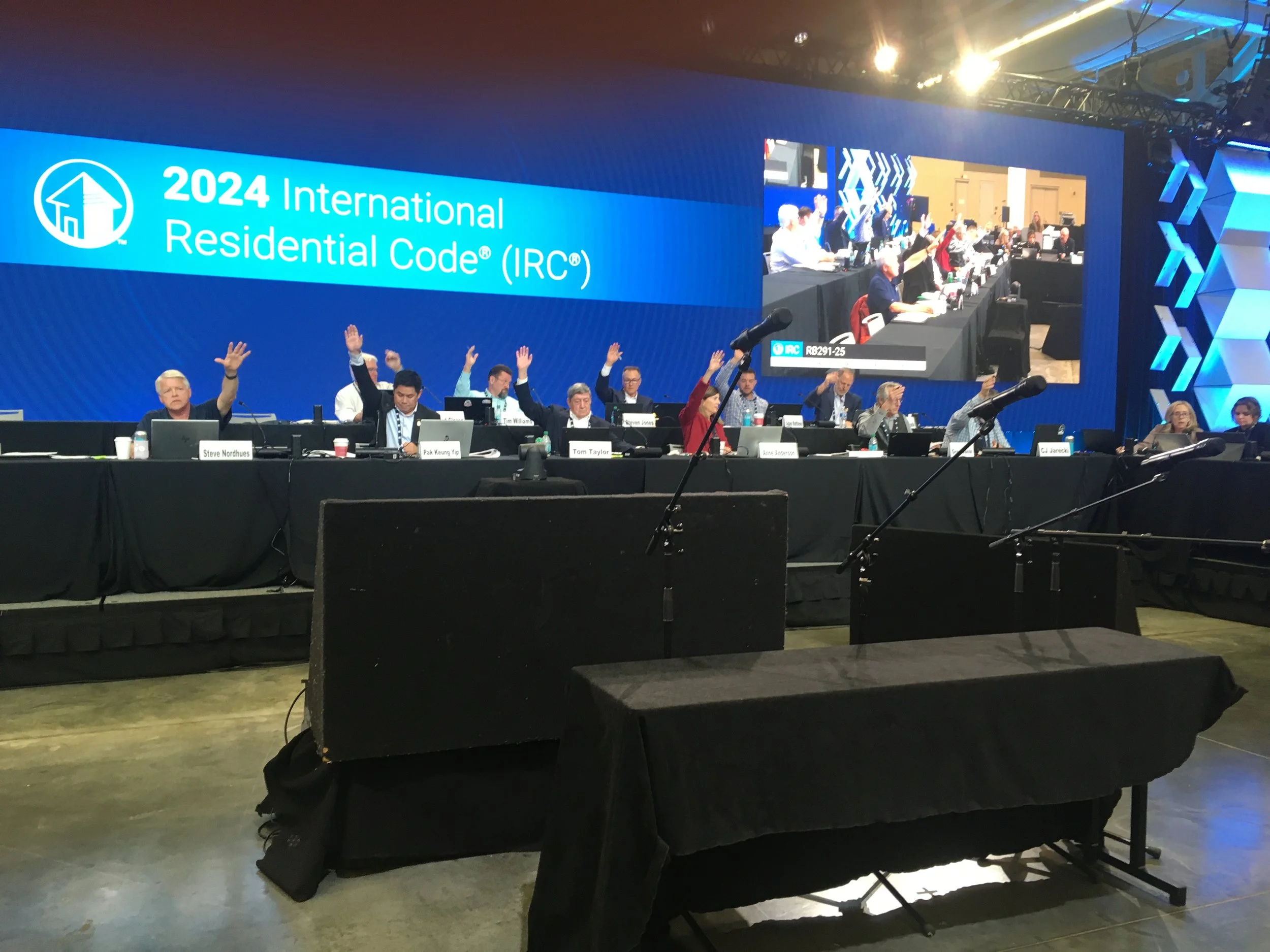
Members of the International Residential Code Committee approve updates to Appendix BL unanimously 11-0 at the IRC Hearings in Cleveland, Oct. 23, 2025. Photo courtesy of Martin Hammer

Hempcrete Fire-Testing Updates Approved for 2027 US Building Codes
By Jean Lotus & Martin Hammer
Hemp-lime (hempcrete) construction in US residential building codes took a major step forward in Cleveland this week when proposed updates to Appendix BL of the 2027 International Residential Code (IRC) were unanimously approved during the International Code Council (ICC) Committee Week proceedings. An online fundraiser successfully raised more than $12,000 to pay for the code adoption.
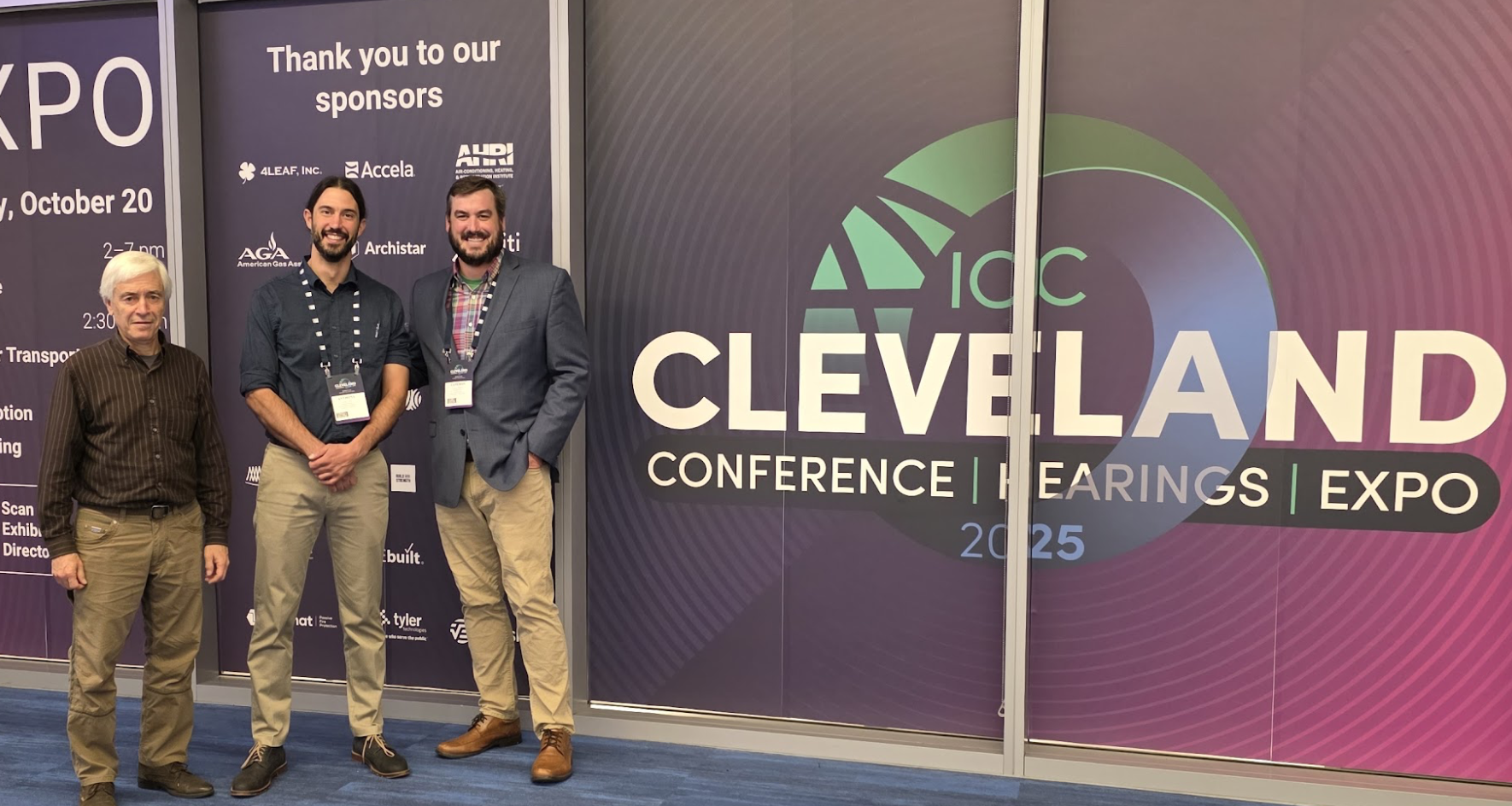
Hempcrete code warriors (L-R) Martin Hammer, Anthony Dente and Cameron McIntosh attended ICC Public Hearings in Cleveland last week to push updates through for hemp-lime in the model residential US building code. Photo courtesy of Cameron McIntosh
It’s an important milestone for hemp-lime construction in the United States because the updated codes will include fire-rated walls in the appendix. Hemp-lime construction was first approved for the 2024 IRC.
Architect Martin Hammer and engineer Anthony Dente, both based in Berkeley, CA, joined Cameron McIntosh, a Pennsylvania-based hempcrete subcontractor and founder of Americhanvre Cast Hemp, to submit the updates heard on Oct. 23 before the IRC committee, which approved the changes 11-0.
“Although inclusions like these may seem obvious to those of us in the field, it is never a guarantee that they will be approved at the hearings for many, possibly logistical reasons,” Dente wrote in an email to HempBuild Mag. “The committee expressed satisfaction will the diligence of the team and the fact checking we did and presented to them and it’s the community’s funding support that helps us do that work.”
The approved changes for the first time incorporated fire-rated hemp-lime wall assemblies into the appendix, based on three ASTM E-119 one-hour fire tests. The tests were facilitated by Cameron McIntosh and conducted by Intertek Laboratories in York, PA in 2024 and 2025.
At the previous hearings in May in Orlando, FL, clarifications to include plaster when classifying a hemp-lime wall as a mass wall were approved. Mass walls have lower R-value requirements in most climate zones because the mass improves thermal performance.





Funding came from a crowdfunding campaign hosted on GiveButter and sponsored by HempBuild Magazine, Hemp Build School, and Americhanvre, which in one month raised $12,300 from about 40 donors. The funds covered the costs of code proposal preparation, attendance and testimony at ICC hearings, and related expenses.
“We are humbled and encouraged by the response to this fundraiser,” McIntosh said.
“Many of our donors were steadfast industry supporters who have been there to raise visibility of bio-based hemp construction through the years, yet we also had many new supporters from various construction professions. Their interest and support signals we are making strides where it counts. Thank you all for supporting this work.”


Why the Code was Updated
The IRC covers one- and two-family dwellings, townhouses, and their accessory structures. It is updated every three years and is the serves as the model residential code for 49 states. (Wisconsin is the only exception). However, adopting the appendices is voluntary. But already jurisdictions such as the City of Austin, TX and the state of Minnesota have adopted Appendix BL from the 2024 IRC for their 2026 residential code, giving a clear path for hemp-lime construction in those jurisdictions. Other jurisdictions, especially with advocacy, are likely to follow suit.
In jurisdictions where Appendix BL has not been adopted, the appendix can always be proposed to the local building official on a project basis. Its use is often granted because of the associated credibility of the IRC, and it is typically preferred to no guidance at all.
Even though hemp-lime has been proven fire-resistant in the EU for decades, US building departments are seeking confirmation, specifically through ASTM E119 and E84 tests, that hemp-lime is fire resistant. As wildfires and extreme climate events increase, the performance of mineral-based, highly fire-resistant materials such as hemp-lime is drawing more attention. And unlike petrochemical-derived insulation and foam products, hemp-lime produces no toxic gases if it burns.


“Fire is a rapidly increasing issue for building departments and everyone else,” Tucson-based code co-author David Eisenberg told HempBuild Mag in August. “Having evidence that these are better than conventional construction in terms of fire safety is a big issue.”
Having fire-rated wall assemblies in the codes will save time and money for hemp-lime builders and homeowners going forward when 1-hour walls are required, for example when a wall is less than 5 feet from a property line.
In Oregon, for example, hempcrete builder Karen Rugg of Perennial Building paid $8,000 for ASTM E-119 fire testing in 2022 to secure local approval for a single project. Under the new language, local jurisdictions will be able to rely on the rated assemblies included in the IRC, eliminating the need for costly project-specific testing.


Natural Building Code Warriors
Over the past 15 years, Hammer and Dente, along with Eisenberg, have been instrumental in developing several natural-building appendices, including straw bale, cob (monolithic adobe), light-straw clay, as well as one for tiny houses and expanding the IRC section on crushed stone footings, in addition to the hemp-lime appendix.



Next Steps
With the IRC committee’s approval, the proposed changes move into the Public Comment phase of the 2027 IRC code development process next Spring. No public comment is expected for the Hemp-Lime appendix, which would mean the recently approved proposal would become part of Appendix BL in the 2027 IRC.
If included in the 2027 IRC, these additions to Appendix BL could significantly streamline permitting for hemp-lime builders nationwide—further integrating bio-based, fire-resistant, carbon-storing materials into mainstream construction.
Updates: This article was updated for clarity with the help of co-author Martin Hammer and to add a quote from Anthony Dente.

Please Support Our Classified Advertisers
(To find out more about advertising CLICK HERE).
Publications
Hemp Building Directory 2025 - Guide to the International Hemp Building Industry
Hempsteads: Architectural details for hemp-lime construction, by Timothy Callahan
Architects/Design Pros/Engineers
Next Genesis Design brings natural materials into high-performance building systems and healthy homes. White Salmon, WA
Experienced Natural Building Engineering Services from Verdant Structural Engineers, CA
Green Builders
Build your hempcrete dream house in Austin, TX with Gradek Contracting and Design
High Desert Hemp Homes - Building with hemp in the Rocky Mountains
Experienced Natural Building Engineering Services from Verdant Structural Engineers, CA
Naturalia Construction, Colorado-based Sustainable Construction with Hemp
Design and build your hempcrete home in Colorado’s front range with Healthy Hemp Homes
Aaron Grail Construction, No. Cal: The intersection of art, design and performance
Hemp Building Research and Training
Hemp Build School online and IRL for Homeowners and Professionals
Follow the Hemp Casita to learn more about building with hemp.
Hemp Hurd (shivs)/Hemp Fiber/ Hemp Microfiber
CannaVision, Fort Worth, TX: Home of the Pulsewave Hemp Processor
IND HEMP: Supporting Farm Families and Rural Communities with Natural Materials Processing
Wyoming Hemp Company - Industry-leading industrial hemp suppliers
Aggricrete, TX, Natural Materials with Superior Sustainability
Hempcrete installers/Insulation subcontractors
Americhanvre Cast Hemp: Supplies, Equipment, Experienced Hempcrete Installation
Hemp Build Network: We Make Building with Hemp Possible, New Braunfels, TX
Hemp Building Company: Hempcrete installation, supplies Lafayette, CO
Hemp Batt Insulation/Supplies
Lime Binder
Hemp Wall Panel Products
Preorder your hempcrete tiny house from Sativa Building Systems
Panel solutions from Homeland Hempcrete
Hemp Composite Boards
Bison Biocomposites produces sustainable thermal insulation, hempcrete, hemp hurd, and more.
Hemp Blocks