Hemp Retrofit Planned for South Bronx Tenement in NYC
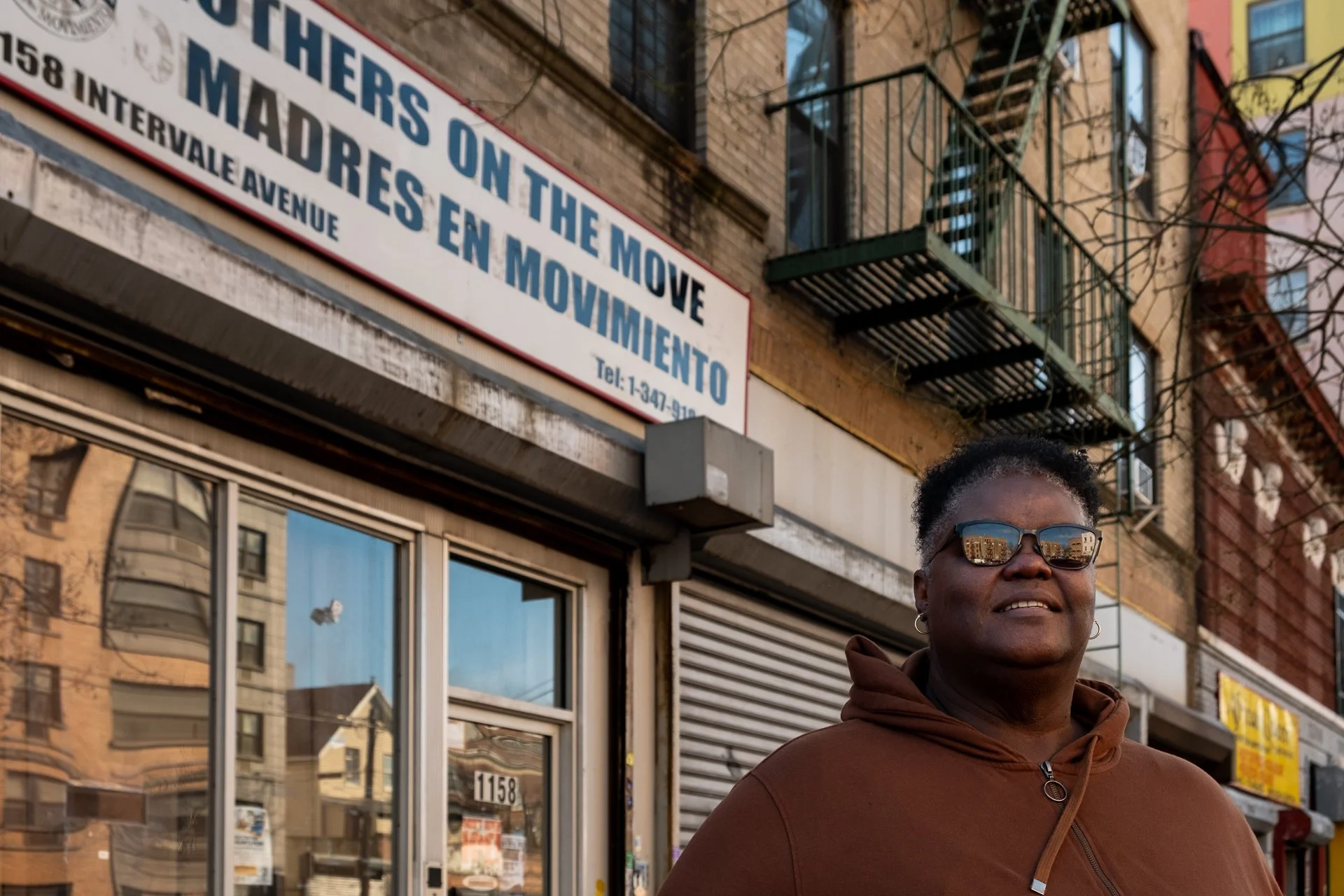
Wanda Salaman, of Mothers on the Move, standing in front of her office in the Bronx. The group has been working with students at Pratt Institute to explore how hemp could improve local housing conditions. (Adi Talwar/City Limits)
By MARIAPAULA GONZALEZ
This article was republished from City Limits, an independent, investigative news source.
Students from the Pratt Institute are teaming up with local community group Mothers on the Move to explore how hemp—a building material rarely used in housing—could help retrofit New York’s oldest buildings, improving indoor air quality and lowering heating and cooling emissions.
On a recent Thursday in the South Bronx, the front door of a shabby aluminum storefront swung open and a group of architecture students slipped inside, notebooks in hand. The room—dim, cramped, and lined with water-stained walls—typically serves as the meeting space for Mothers on the Move, a community group that has spent decades pressing for better housing conditions in the neighborhood. This afternoon, it doubled as a makeshift classroom.
Twelve students from Pratt Institute fanned out across the space, crouching to examine cracks in the plaster and tracing the outlines of a floor plan spread across a folding table. Their assignment was to imagine how one of the city’s most environmentally-burdened neighborhoods might benefit from a building material almost never used in New York City housing: hemp.




The partnership is the latest chapter in Mothers on the Move’s nearly 30-year fight against the environmental and housing conditions that have long made the South Bronx a national symbol of urban health disparities. Bronx residents have the highest adult asthma rate in the city—21 percent, compared to 14 percent citywide—driven by proximity to highways, industry, and aging, poorly ventilated buildings.
“We get sick,” said Wanda Salaman, the group’s executive director. “But some of our apartments that we live in are sicker than us.”



For families like hers, the numbers are not abstract. A 2013 study showed that nearly half of South Bronx households reported having mold and pests, and more than 60 percent lacked basic kitchen and bathroom ventilation. The consequences were predictable: residents experienced more than a week’s worth of asthma symptoms each month. When some families relocated to healthier buildings with proper ventilation, emergency room visits dropped to zero within 18 months, the study found.
Now, students and faculty from Pratt believe hemp—a lightweight, carbon-storing plant fiber—could help retrofit New York’s oldest housing stock while improving indoor air quality and lowering heating and cooling emissions.
For three months, Pratt students reimagined an apartment building near Mothers on the Move and developed retrofit proposals that span from individual units to the entire building. This spring, they’ll get the chance to pitch their ideas to community residents, local politicians, and some of the top city housing agencies, including representatives from the New York City Housing Authority and the city’s Department of Housing Preservation & Development.
Funded in part by the class’s $12,000 budget, the exhibition aims to secure approval to retrofit an office space at Mothers on the Move. If the students’ ideas gain traction, they say the project would mark the first hemp-based renovation of a multifamily apartment in the United States.
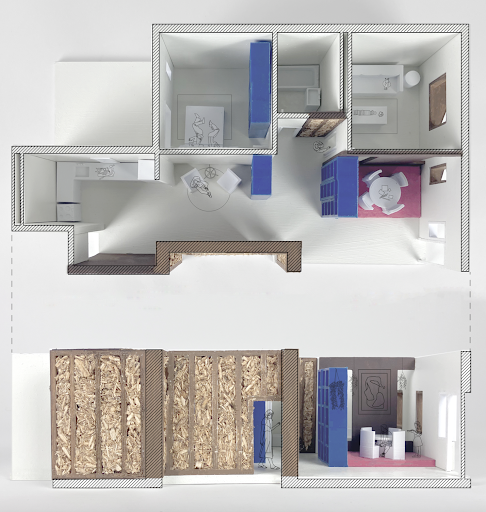
Lopez and Ortiz-Reyes created 3D models of their modular layouts, featuring textured hempcrete walls designed for kitchens and bathrooms to improve ventilation. (Photo by Alexsa Ortiz-Reyes)
A neighborhood’s past shapes its experiments with the future
Salaman has lived through the neighborhood’s cycle of disinvestment and reinvention. After arriving from Puerto Rico at 8 years old, she moved eight times across the South Bronx from 1975 to 1989, navigating mold outbreaks, apartment fires, lead-tainted water, and air thick with highway exhaust. For her, the conditions in many buildings today look painfully familiar.
That history is part of why she has embraced unconventional collaborations. In 2022, following New York’s push to relax cannabis criminalization laws, Salaman worked with Pratt planning students to study the economic impact of legalization. When the team discovered industrial hemp—non-psychoactive, fast-growing, and increasingly used in sustainable construction—the idea clicked.
If hemp could be used to build houses elsewhere, why not here? “It has more than 50,000 uses,” Salaman said. “Why are we not using this in our communities?”
New York City’s climate legislation added urgency. Buildings account for more than two-thirds of citywide greenhouse gas emissions, and Local Law 97 requires owners to reduce emissions by 40 percent in five years or face steep penalties.
Much of that pollution comes from heating systems—old boilers fueled by gas or oil that leak methane and waste energy. Nearly half of the energy used in buildings is dedicated to heating and cooling systems, and the larger part of that comes from the combustion of chemical products made of petroleum, natural gas, and other fossil fuels.
Bhavini Kapur, a sustainable architect who graduated from Pratt last May, was one of the planning students working with Salaman on industrial hemp. She ended up dedicating her thesis to the idea that hemp could be integrated into apartment buildings, and now she’s working closely with the students to help their projects come to life.
During her research, Kapur discovered how hemp could transform from a tiny seed to an insulating material in buildings. Inside the cannabis plant lies a woody center that harvesters cut up into small pieces, also known as hemp hurd. That mixed with lime creates hempcrete, which resembles a mud-like substance that can be made on site.







Hempcrete is light, insulating, easier to transport than concrete, and serves as both structure and insulation. Replacing traditional fiberglass or foam with hemp could cut energy use and eliminate some materials linked to respiratory issues.
While it’s been traditionally marketed as a material for single-home, residential construction, hemp offers a more affordable option for architects using concrete or other carbon-heavy materials. For a conventional wood-frame wall, there are several layers—studs, drywall, sheathing, vapor barrier, and siding. But a hempcrete wall is just made up of studs, hempcrete, and lime coats inside and out.
“It’s simpler and uses fewer materials,” said Ali Memari, chair of residential construction at Penn State University. “Hempcrete can serve as the filler and insulation. So, it’s economical because it replaces multiple layers with one.”
Even with hemp’s criminalized past, Kapur believes the material could spark up some curiosity in communities around the city. “It’s been such a politically charged subject for such a long time with the war on drugs,” she said. “But hemp is a great way to catch attention because of its relation with cannabis, and it’s also a great prototype of how a lot of other bio materials can become part of this discussion, too.”
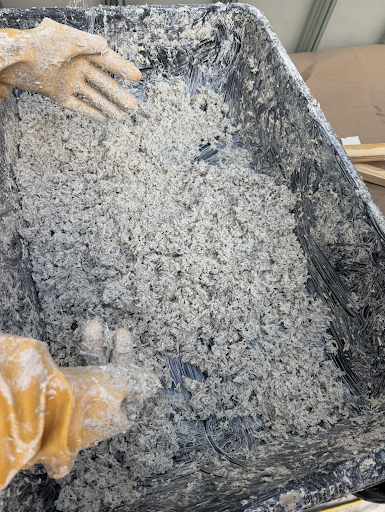
Pratt students mixed hemp hurd and lime in a patio outside of the architecture building during a workshop class on Nov. 22, 2025. (Photo by Mariapaula Gonzalez)


Hemp has already found its way into multifamily retrofits overseas. In 2012, architects in Paris completed a hemp-insulated renovation in 2012, while using mass timber as structure. In the U.S., researchers are catching up: Rensselaer Polytechnic Institute received a $1.5 million three-year federal grant this March to develop low cost hemp-based insulation panels in single-family homes.
Still, no one has attempted a New York City apartment retrofit—until, potentially, now.
Students take on a 1925 Bronx tenement building
In December, Pratt students presented their midterm proposals for 1149 Tiffany St., a five-story, 1925 tenement owned by the Banana Kelly Housing Association. The building sits directly above Mother on the Move’s storefront office.
For some, the project is personal. Crystar Lopez, 22, grew up in a pre-war, rent-stabilized apartment near the Foxhurst neighborhood and says the area isn’t as walkable since it’s close to the industrial district. “Since people don’t really go out, home has to be a place where they feel comfortable,” Lopez said.




After speaking with Salaman in September to brainstorm project ideas, Lopez and her partner Alexsa Ortiz-Reyes clung to one issue she raised: many families live in apartments with rigid layouts. So, her team focused on creating flexible spaces for families. Their proposal uses temporary, non-destructive walls—finished in hemp lime plaster or compressed hemp blocks—to create modular layouts that comply with city building codes for light and ventilation.
The problem with creating subdivided rooms in the city is that most rarely adhere to the New York City Housing Maintenance Code, which requires that all bedrooms have a window, be at least 80 square feet in area, and that living rooms have natural light. To combat this, Lopez and Ortiz-Reyes designed plans for five different layouts that follow these regulations.
“Before residents move in, they would say, ‘Okay, I need this type of layout,'” Lopez said. “It’s like building your own IKEA apartment.”
The environmentally-friendly flex walls would allow families to create an additional bedroom or living space while still being up to code. Residents could request kits that would include modular curtain rods, storage walls, and a raised floor and pick them up at the Mothers on the Move office. They would also receive a pamphlet showing assembly instructions and different layouts they could create based on their needs.
“New York State is uniquely positioned to lead a circular bioeconomy around hemp,” Walczyk said, “with farmers ready to grow, universities advancing R&D, startups producing feedstocks and products, and the nation’s largest concentration of architects and builders.”
This article was republished from City Limits, an independent, investigative news source.


Please Support Our Classified Advertisers
(To find out more about advertising CLICK HERE).
Publications
PRE SALE: Hemp Building Directory 2026 - Guide to the International Hemp Building Industry
Hempsteads: Architectural details for hemp-lime construction, by Timothy Callahan
Architects/Design Pros/Engineers
Next Genesis Design brings natural materials into high-performance building systems and healthy homes. White Salmon, WA
Bio-based Engineering and Design at Crownjade Design & Engineering, Greeley, CO
Experienced Natural Building Engineering Services from Verdant Structural Engineers, CA
Green Builders
Naturalia Construction, Colorado-based Sustainable Construction with Hemp
Design and build your hempcrete home in Colorado’s front range with Healthy Hemp Homes
Aaron Grail Construction, No. Cal: The intersection of art, design and performance
Evolve Construction: Providing healthy, sustainable, housing for future generations. Northern CO
Hemp Building Research and Training
Hemp Build School online and IRL for Homeowners and Professionals
Follow the Hemp Casita from Right Coast Hemp to learn more about building with hemp.
Hemp Hurd (shivs)/Hemp Fiber/ Hemp Microfiber
CannaVision, Fort Worth, TX: Home of the Pulsewave Hemp Processor
Riverdale Hemp Gin producing hemp raw materials in the Central Valley (CA)
IND HEMP: Supporting Farm Families and Rural Communities with Natural Materials Processing
E3 Agriculture: Texas plant-based materials for construction, industry, and agriculture.
East Coast Hemp Supply: Your source for hemp building materials in NC
Prairie Band Ag. Hemp Hurd Cultivating a future rooted in nature. Holton KS
Hempcrete installers/Insulation subcontractors
Americhanvre Cast Hemp: Supplies, Equipment, Experienced Hempcrete Installation
Hemp Build Network: We Make Building with Hemp Possible, New Braunfels, TX
Hemp Building Company: Hempcrete installation, supplies Lafayette, CO
Victura Hemp: Spray-applied hemp installation in New England
Hemp Batt Insulation/Supplies
Lime Binders, Plasters and Mineral Paints
US Heritage Group: Experienced Hemp Building Binder Suppliers
Hemp and Block, LLC- Hempcrete Binder
Earthaus specialty lime plasters for the health & beauty of authentic mineral finishes
Silacote Environmentally Safe Inorganic Paints (CA and Canada)
Magic Minerals hemp-lime catalyst: Proven success. Made in USA
Machine Manufacturing Companies
Quadra Concrete robotics and specialty machines in France and Phoenix, AZ USA
Hemp Wall Panel Products
Preorder your hempcrete tiny house from Sativa Building Systems
Panel solutions from Homeland Hempcrete
Hemp Hardwood and Flooring:
Hemp Blocks