Construction Materials from Ag Streams and Landfill Waste

Materials engineer Miles Gathright of Florida-based Boardwurks Biocomposites is developing carbon-smart construction panels made from plants and recycled composites.
This profile originally appeared in Hemp Today
INTERVIEW: Miles Gathright is co-founder of Boardwurks Biocomposites, a Florida-based innovator developing carbon-smart construction panels made from hemp hurd and recycled composites. With more than two decades in the performance composites industry, Gathright brings deep technical expertise and a sustainability-first mindset to the challenge of replacing conventional materials with natural, circular alternatives.
HT: Boardwurks is clearly rooted in sustainability. What problem were you trying to solve when you started the company?
Miles Gathright: Boardwurks was founded to address a critical gap in sustainable construction materials. Traditional composites and building panels are heavily reliant on fossil fuels and toxic adhesives, contributing significantly to carbon emissions and landfill waste. We saw an opportunity to turn waste into value by upcycling decommissioned wind turbine blades, derelict fiberglass from marine vessels, and agricultural byproducts like bagasse and corn stover. We also focused on purpose-grown sustainable crops like hemp, kenaf, and miscanthus, which not only sequester carbon but thrive with low environmental impact. Our mission is to transform these waste streams and sustainable fibers into high-performance, carbon-smart construction materials that challenge conventional particleboard and MDF in both durability and sustainability.





HT: You’ve worked in composites for more than 20 years. How did hemp enter the picture?
MG: Hemp entered the picture as part of our commitment to finding sustainable and renewable feedstocks that perform. Its exceptional strength, rapid growth cycle, and ability to sequester carbon made it an ideal material for our composite panels. When we looked at decarbonizing our footprint without sacrificing performance, hemp stood out as a perfect solution. Integrating hemp hurd into our thermocompression process allowed us to produce panels that are stronger, lighter, and far more sustainable than conventional alternatives.
HT: The hemp sector often struggles with quality and supply consistency. How are you managing those challenges?
MG: We’ve tackled this head-on by establishing long-term partnerships with decorticators and farmers. Our supply agreements prioritize quality control and sustainable farming practices. We also diversify our sourcing with a regional strategy: partnering with processors in areas where hemp production is stable and growing. This layered approach ensures we maintain consistent quality and supply, even during market fluctuations.

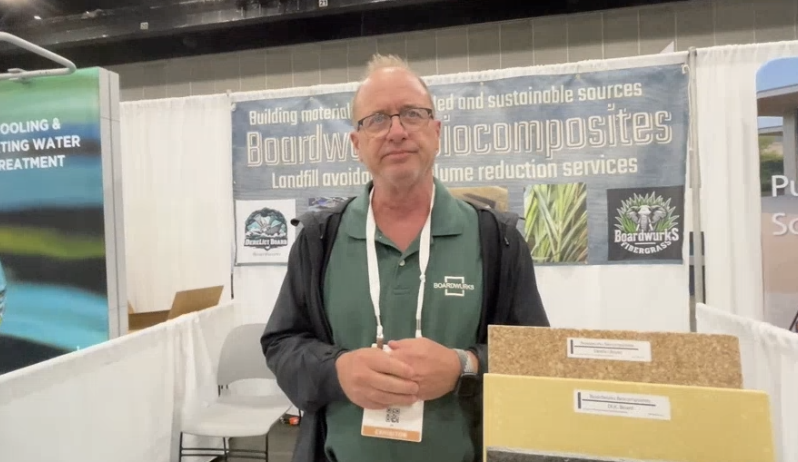
Boardwurks’s booth at Greenbuild 2025 in Los Angeles. Photo courtesy Jean Lotus
HT: From a sustainability perspective, how does Hempboard compare to traditional particleboard or MDF?
MG: Hempboard sets a new standard for sustainable construction. Unlike traditional particleboard or MDF, which rely on formaldehyde-based adhesives and fossil-fuel-derived resins, Hempboard is made with natural fibers and eco-friendly binders. It’s formaldehyde-free, water-resistant, and stronger per weight. Additionally, the hemp we use sequesters significant amounts of carbon during its growth, making Hempboard not just carbon-neutral, but carbon-negative. It’s a solution that’s better for the environment without compromising on performance.
HT: Do you see the future of biocomposites as competing with conventional materials—or displacing them entirely?
MG: We see biocomposites as more than just competition—they’re the future of sustainable building. As demand for low-carbon materials grows, traditional particleboard and MDF are losing ground. With advancements in processing and supply chain efficiency, biocomposites like Hempboard and our DerelictBOARD made from reclaimed FRP are poised to replace these conventional materials outright. We’re committed to driving that shift through innovation and scalability.




HT: What kinds of buyers or industries are showing the most interest in your materials right now?
MG: Currently, we’re seeing strong demand from non-structural applications where sustainability is a core priority. Right now, the primary hurdle is certification for structural applications under International Building Code (IBC) and International Residential Code (IRC). Pursuing these certifications is a top priority for Boardwurks, and we are collaborating with academic partners to expedite testing and validation. Achieving IBC and IRC approval is essential for broader market adoption, including big-box retailers and structural insulated panel (SIP) manufacturers. This effort is significant, not just for us but for the entire biocomposite industry.



HT: How important is regional fiber supply to the Boardwurks model—and how do you view the growth of U.S. hemp processing?
MG: Regional fiber supply is fundamental to our model. Our “75-Bale Mile Radius” strategy means positioning microplants adjacent to first-transformation decorticators or waste stream processors to minimize transport emissions and processing costs. We’re working with local agricultural waste streams—bagasse in Florida, corn stover in the Midwest— and blending them with higher-value, purpose-grown materials An exciting development we are pioneering is our “super-hybrid” composites, which combine carbon-sequestering natural fibers like hemp with reclaimed FRP from decommissioned wind turbine blades. This innovation is setting a new standard for sustainable, high-performance building materials. We see the growth of U.S. hemp processing as crucial to scaling this model, supporting local economies while reducing carbon footprints.






Please Support Our Classified Advertisers
(To find out more about advertising CLICK HERE).
Publications
Hemp Building Directory 2025 - Guide to the International Hemp Building Industry
Hempsteads: Architectural details for hemp-lime construction, by Timothy Callahan
Architects/Design Pros/Engineers
Next Genesis Design brings natural materials into high-performance building systems and healthy homes. White Salmon, WA
Bio-based Engineering and Design at Crownjade Design & Engineering, Greeley,CO
Experienced Natural Building Engineering Services from Verdant Structural Engineers, CA
Green Builders
Build your hempcrete dream house in Austin, TX with Gradek Contracting and Design
High Desert Hemp Homes - Building with hemp in the Rocky Mountains
Experienced Natural Building Engineering Services from Verdant Structural Engineers, CA
Naturalia Construction, Colorado-based Sustainable Construction with Hemp
Design and build your hempcrete home in Colorado’s front range with Healthy Hemp Homes
Aaron Grail Construction, No. Cal: The intersection of art, design and performance
Hemp Building Research and Training
Hemp Build School online and IRL for Homeowners and Professionals
Follow the Hemp Casita to learn more about building with hemp.
Hemp Hurd (shivs)/Hemp Fiber/ Hemp Microfiber
CannaVision, Fort Worth, TX: Home of the Pulsewave Hemp Processor
Riverdale Hemp Gin producing hemp raw materials in the Central Valley (CA)
IND HEMP: Supporting Farm Families and Rural Communities with Natural Materials Processing
E3 Agriculture: Texas plant-based materials for construction, industry, and agriculture.
Hempcrete installers/Insulation subcontractors
Americhanvre Cast Hemp: Supplies, Equipment, Experienced Hempcrete Installation
Hemp Build Network: We Make Building with Hemp Possible, New Braunfels, TX
Hemp Building Company: Hempcrete installation, supplies Lafayette, CO
Victura Hemp: Spray-applied hemp installation in New England
Hemp Batt Insulation/Supplies
Lime Binders, Plasters and Mineral Paints
US Heritage Group: Experienced Hemp Building Binder Suppliers
Hemp and Block, LLC- Hempcrete Binder
Earthaus specialty lime plasters for the health & beauty of authentic mineral finishes
Silacote Environmentally Safe Inorganic Paints (CA and Canada)
Machine Manufacturing Companies
Quadra Concrete robotics and specialty machines in France and Phoenix, AZ USA
Hemp Wall Panel Products
Preorder your hempcrete tiny house from Sativa Building Systems
Panel solutions from Homeland Hempcrete
Hemp Composite Boards
Bison Biocomposites produces sustainable thermal insulation, hempcrete, hemp hurd, and more.
Hemp Blocks