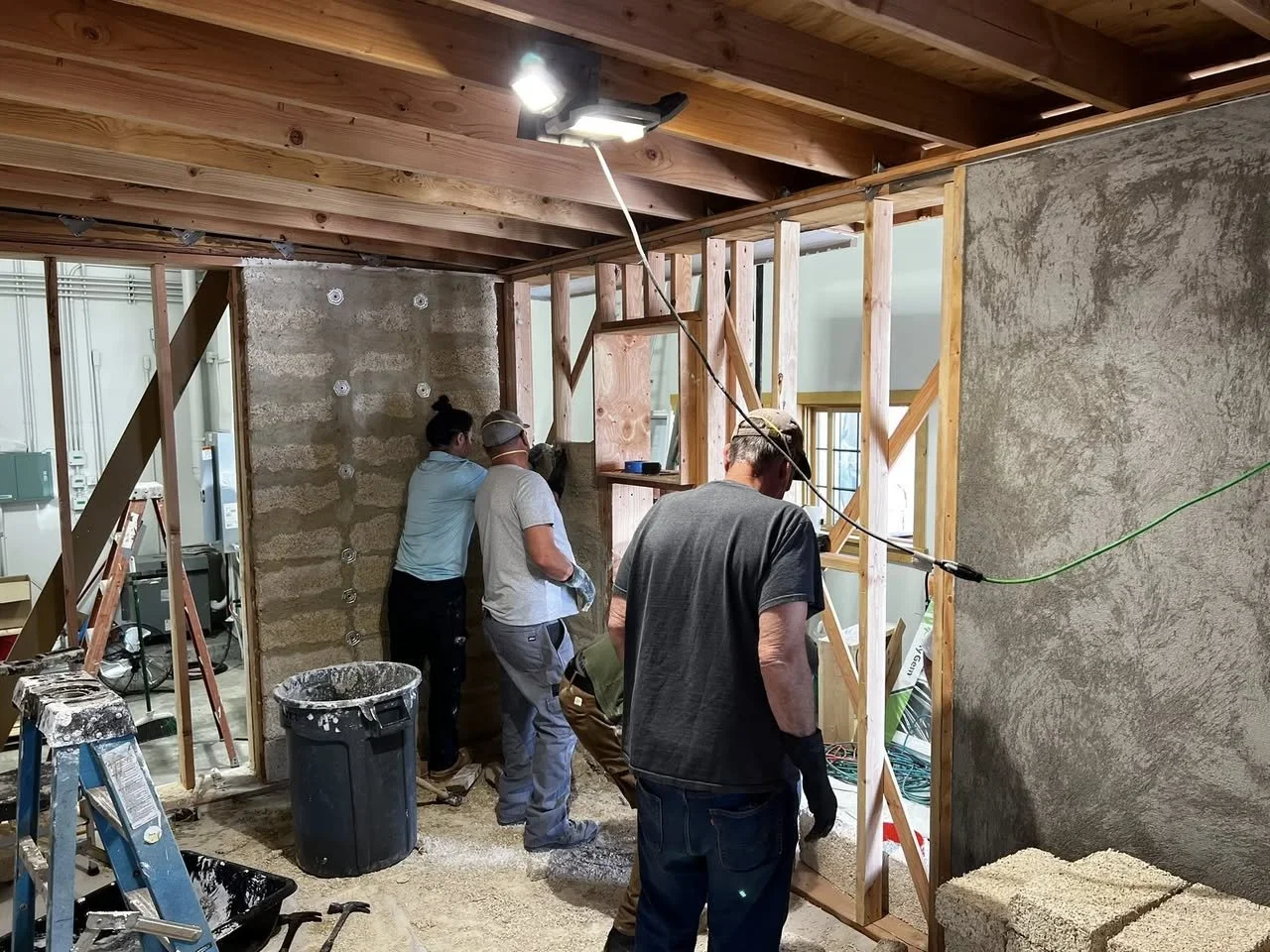
Workshop participants build a hempcrete demonstration structure at Oregon State University in June 2026 in Corvallis OR. Photo courtesy of Gina Engel

By Jeffrey Steiner and Zhaohui Wu
This article is derived from a chapter in Achieving Sustainable Cultivation of Hemp (2026), edited by Professor Emeritus Jay Stratton Noller and published by Burleigh Dodds Science Publishing.
The emergence of hemp-based construction materials presents an opportunity that extends well beyond individual building projects. It offers a pathway for connecting agricultural production, materials processing, manufacturing, workforce development, and regional economic growth.
Hemp-lime construction materials provide an especially compelling example. Their value proposition includes thermal performance, moisture management, and the potential to reduce the environmental footprint of certain building assemblies. Yet their broader economic significance may lie in creating demand for locally and regionally produced agricultural materials that can support new manufacturing enterprises.





Building such an industry requires more than expanding hemp acreage. It requires coordinated investments in harvesting equipment, decortication and fiber separation technologies, materials processing facilities, product testing, manufacturing capacity, and workforce training.
Regional supply chains can be particularly important. Transporting bulky, relatively low-density agricultural biomass over long distances can impose substantial costs. Locating appropriate processing operations closer to agricultural production areas, while connecting processed materials with established manufacturing and construction markets, offers opportunities to improve efficiency and competitiveness.



An additional advantage comes from utilizing multiple components of the hemp plant. While hurd can supply hemp-lime construction systems, bast fibers can serve insulation, engineered composites, and textile applications. Developing complementary markets for these materials can improve processing economics and distribute financial risks across several product sectors.




The social and economic implications are equally important. Hemp-based building materials can support workforce development, create new business opportunities in rural communities, and contribute to efforts to address housing needs, including those of underserved and Indigenous populations.


Realizing these opportunities will require collaboration among farmers, processors, manufacturers, builders, researchers, investors, and policymakers. Technical standards, verified material performance, consistent product quality, and dependable market relationships will be essential.


The objective should not be to recreate conventional construction-material supply chains using a different feedstock. Instead, hemp offers an opportunity to rethink how agricultural resources are transformed into manufactured building products through more efficient, resilient, and regionally integrated systems.
The greatest contribution of hemp to the built environment may ultimately be the new relationships it creates between agriculture, manufacturing, construction, and the communities these industries serve.







Achieving Sustainable Cultivation of Hemp (2026), edited by Professor Emeritus Jay Stratton Noller and published by Burleigh Dodds Science Publishing.
Please Support Our Classified Advertisers
(To find out more about advertising CLICK HERE).
Publications
NOW ON SALE! Hemp Building Directory 2026 - Guide to the International Hemp Building Industry
Hempsteads: Architectural details for hemp-lime construction, by Timothy Callahan
Architects/Design Pros/Engineers
Next Genesis Design brings natural materials into high-performance building systems and healthy homes. White Salmon, WA
Bio-based Engineering and Design at Crownjade Design & Engineering, Greeley, CO
Experienced Natural Building Engineering Services from Verdant Structural Engineers, CA
Green Builders
Naturalia Construction, Colorado-based Sustainable Construction with Hemp
Design and build your hempcrete home in Colorado’s front range with Healthy Hemp Homes
Aaron Grail Construction, No. Cal: The intersection of art, design and performance
I Grow Homes, LLC: Illinois based hemp grower and builder of healthy homes.
Evolve Construction: Providing healthy, sustainable, housing for future generations. Northern CO
Hemp Building Research and Training
Hemp Build School online and IRL for Homeowners and Professionals
Follow the Hemp Casita from Right Coast Hemp to learn more about building with hemp.
Hemp Hurd (shivs)/Hemp Fiber/ Hemp Microfiber
Riverdale Hemp Gin producing hemp raw materials in the Central Valley (CA)
IND HEMP: Supporting Farm Families and Rural Communities with Natural Materials Processing
E3 Agriculture: Texas plant-based materials for construction, industry, and agriculture.
East Coast Hemp Supply: Your source for hemp building materials in NC
Prairie Band Ag. Hemp Hurd Cultivating a future rooted in nature. Holton KS
Hempcrete installers/Insulation subcontractors
Americhanvre Cast Hemp: Supplies, Equipment, Experienced Hempcrete Installation
Hemp Build Network: We Make Building with Hemp Possible, New Braunfels, TX
Hemp Building Company: Hempcrete installation, supplies Lafayette, CO
Victura Hemp: Spray-applied hemp installation in New England
Hemp Batt Insulation/Supplies
Lime Binders, Plasters and Mineral Paints
US Heritage Group: Experienced Hemp Building Binder Suppliers
Hemp and Block, LLC- Hempcrete Binder
Earthaus specialty lime plasters for the health & beauty of authentic mineral finishes
Silacote Environmentally Safe Inorganic Paints (CA and Canada)
Magic Minerals hemp-lime catalyst: Proven success. Made in USA
Machine Manufacturing Companies
Quadra Concrete robotics and specialty machines in France and Phoenix, AZ USA
Hemp Wall Panel Products
Preorder your hempcrete tiny house from Sativa Building Systems
Panel solutions from Homeland Hempcrete
Hemp Hardwood and Flooring:
Hemp Blocks