Lower Sioux Hempcrete Program Advances Local Farming
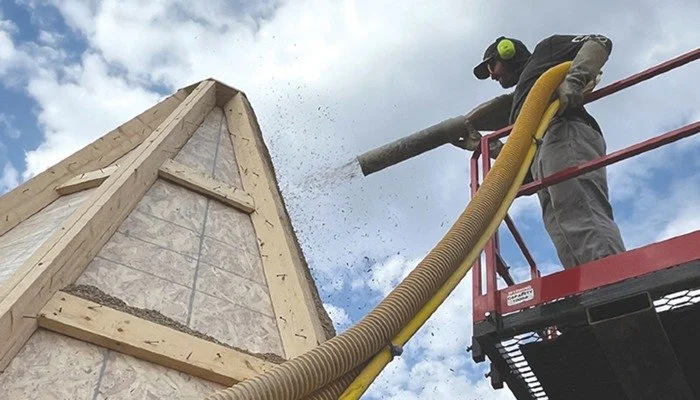
There Ereasy spray system was used on the Morton, MN Lower Sioux reservation for a prototype hempcrete teepee. Photo courtesy of Lower Sioux Hemp Program

This article originally appeared in Land and Life Magazine
By Taylor Hugo
The Lower Sioux Indian Community is on a mission to get its members into healthier homes. Since 2016, the indigenous community, located in Morton, Minnesota, has been growing the main material necessary to build affordable, sustainable homes right on the reservation: hemp.
“You can grow your home right in your community and teach your people how to build with those materials. You give them jobs; you give them homes,” says Danny Desjarlais, the Lower Sioux’s industrial hemp construction project manager. “Our goal is just trying to rebuild our community but also maybe inspire others to do the same for their communities.”



A Complicated History
Not many people know hemp can be grown and used for building homes, among a multitude of other purposes—55,000 and counting, according to Joey Goodthunder, a farmer for the Lower Sioux. While it’s not as widely farmed today, industrial hemp has been part of U.S. agriculture for centuries, even before the U.S. became its own country.
After taking root overseas in China and Europe, hemp was brought to New England by the Puritans in 1645, where they used it as a fiber source for household spinning and weaving. The hemp industry continued to spread to states like Virginia, Kentucky, Missouri and Illinois, thanks in part to the U.S. Navy’s strong demand for sailcloth and cordage between 1840 and 1860.




Lower Sioux Hemp building manger Danny Desjarlais speaks at the tribe’s processing facility . Photo by Jean Lotus
“Hemp is what America was built off of,” Desjarlais says. “I tell a lot of people, ‘If you’re a farmer and you have farming somewhere down the line, they were probably hemp farmers. Hemp farming is in your blood if you’re an American farmer.’”
As part of the cannabis family, hemp has had a rocky relationship with the U.S. government. In 1937, Congress passed the Marijuana Tax Act, which required the registration and licensing of all hemp growers with the federal government to restrict the production of marijuana. While this act was aimed at stopping recreational drug users, it also affected the industrial hemp industry, making hemp production less economical.



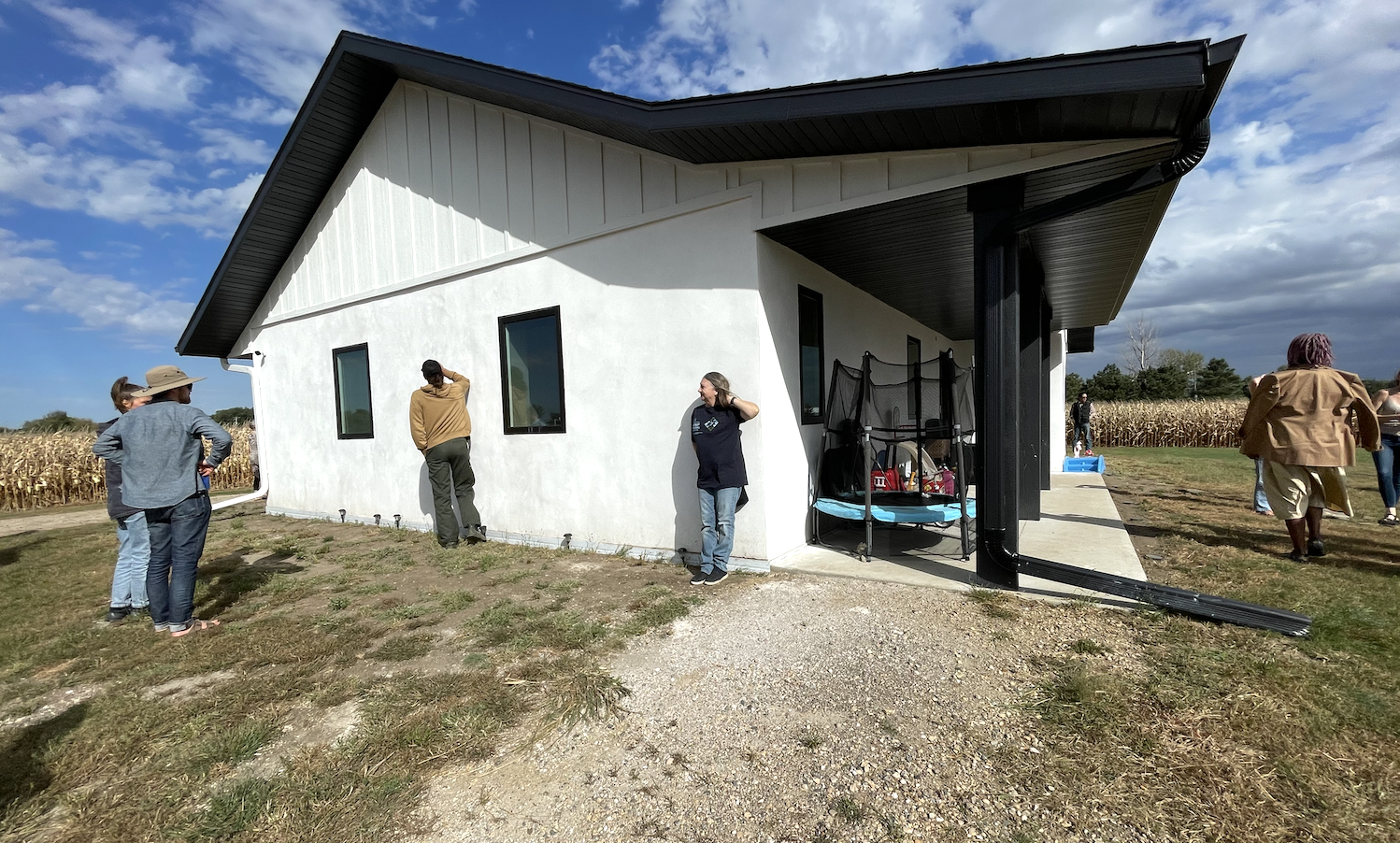
One of the Lower Sioux’s hempcrete homes in Morton, MN. Photo courtesy of Jean Lotus
Then, during World War II, when cheaper hemp alternatives like jute and abaca were unable to be imported, the government instituted an emergency program, called Hemp for Victory, to encourage farmers to produce hemp domestically.
By 1970, however, the Controlled Substances Act (CSA) criminalized the manufacture, distribution and possession of all varieties of cannabis, including hemp. It wasn’t until the 2018 Farm Bill that hemp was removed from the CSA list, allowing hemp with a tetrahydrocannabinol (THC, the psychoactive component of marijuana) concentration of less than 0.3% to be produced for industrial purposes.


Hemp for Homes
For the Lower Sioux Indian Community, growing hemp starts with finding the right variety. “We want one with more hurd in it,” explains Goodthunder. Hurd is the woody, cellulose-rich core of the stalk, a key component for making building materials out of hemp.
Once Goodthunder finds the seed he wants to use, he and his team plant it in mid-April or early May and grow it for 90 days. “Then we come out and cut it and let it ret for three to five weeks,” he adds. “Retting is just a fancy word for rotting out in the field. It’s basically decomposing the glue off the fiber so we can process it for the hurd that we’ll use to build houses.”



The hemp is then round baled and hauled to the Lower Sioux's new processing facility, a $2.3 million project that was completed last year. Desjarlais and Goodthunder are hopeful that the 10,000-square-foot facility will eventually help them produce enough hemp building materials to close the housing gap on the reservation. Desjarlais says the community is about 200 homes short of adequately housing its members, referring to recent data from the U.S. Department of Housing and Urban Development. “We do have a big need for homes,” he says. “There is a lot of overcrowding and a lot of multigenerational living.”
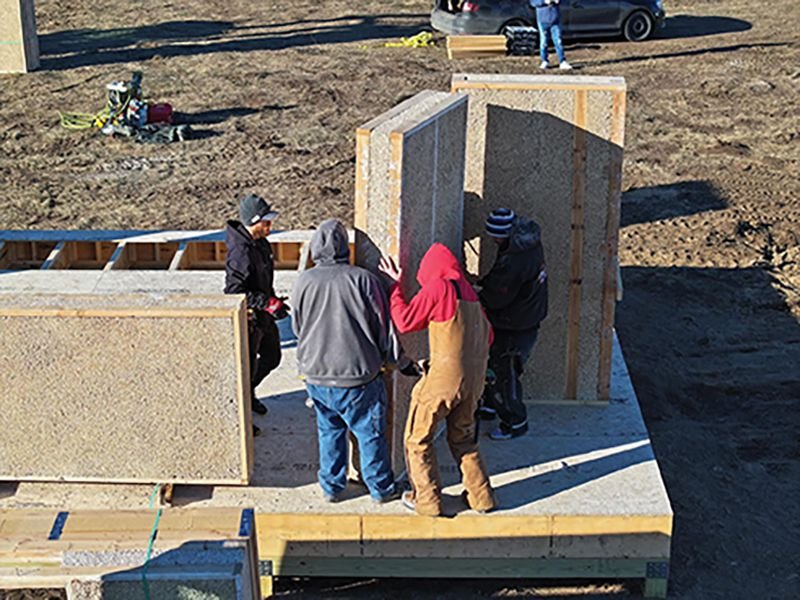
Homeland Hempcrete panels were used to build one of the Lower Sioux hempcrete homes, installed in less than 4 hours. Photo courtesy of the Lower Sioux hempcrete program



READ MORE at Land and Life Magazine




Please Support Our Classified Advertisers
(To find out more about advertising CLICK HERE).
Publications
ON SALE: Hemp Building Directory 2025 - Guide to the International Hemp Building Industry
Hempsteads: Architectural details for hemp-lime construction, by Timothy Callahan
Architects/Design Pros/Engineers
Next Genesis Design brings natural materials into high-performance building systems and healthy homes. White Salmon, WA
Bio-based Engineering and Design at Crownjade Design & Engineering, Greeley, CO
Experienced Natural Building Engineering Services from Verdant Structural Engineers, CA
Green Builders
Naturalia Construction, Colorado-based Sustainable Construction with Hemp
Design and build your hempcrete home in Colorado’s front range with Healthy Hemp Homes
Aaron Grail Construction, No. Cal: The intersection of art, design and performance
Evolve Construction: Providing healthy, sustainable, housing for future generations. Northern CO
Hemp Building Research and Training
Hemp Build School online and IRL for Homeowners and Professionals
Follow the Hemp Casita to learn more about building with hemp.
Hemp Hurd (shivs)/Hemp Fiber/ Hemp Microfiber
CannaVision, Fort Worth, TX: Home of the Pulsewave Hemp Processor
Riverdale Hemp Gin producing hemp raw materials in the Central Valley (CA)
IND HEMP: Supporting Farm Families and Rural Communities with Natural Materials Processing
E3 Agriculture: Texas plant-based materials for construction, industry, and agriculture.
Hempcrete installers/Insulation subcontractors
Americhanvre Cast Hemp: Supplies, Equipment, Experienced Hempcrete Installation
Hemp Build Network: We Make Building with Hemp Possible, New Braunfels, TX
Hemp Building Company: Hempcrete installation, supplies Lafayette, CO
Victura Hemp: Spray-applied hemp installation in New England
Hemp Batt Insulation/Supplies
Lime Binders, Plasters and Mineral Paints
US Heritage Group: Experienced Hemp Building Binder Suppliers
Hemp and Block, LLC- Hempcrete Binder
Earthaus specialty lime plasters for the health & beauty of authentic mineral finishes
Silacote Environmentally Safe Inorganic Paints (CA and Canada)
EcoStucco creates natural pigments for natural lime-based wall systems.
Machine Manufacturing Companies
Quadra Concrete robotics and specialty machines in France and Phoenix, AZ USA
Hemp Wall Panel Products
Preorder your hempcrete tiny house from Sativa Building Systems
Panel solutions from Homeland Hempcrete
Hemp Hardwood and Flooring:
Hemp Blocks