
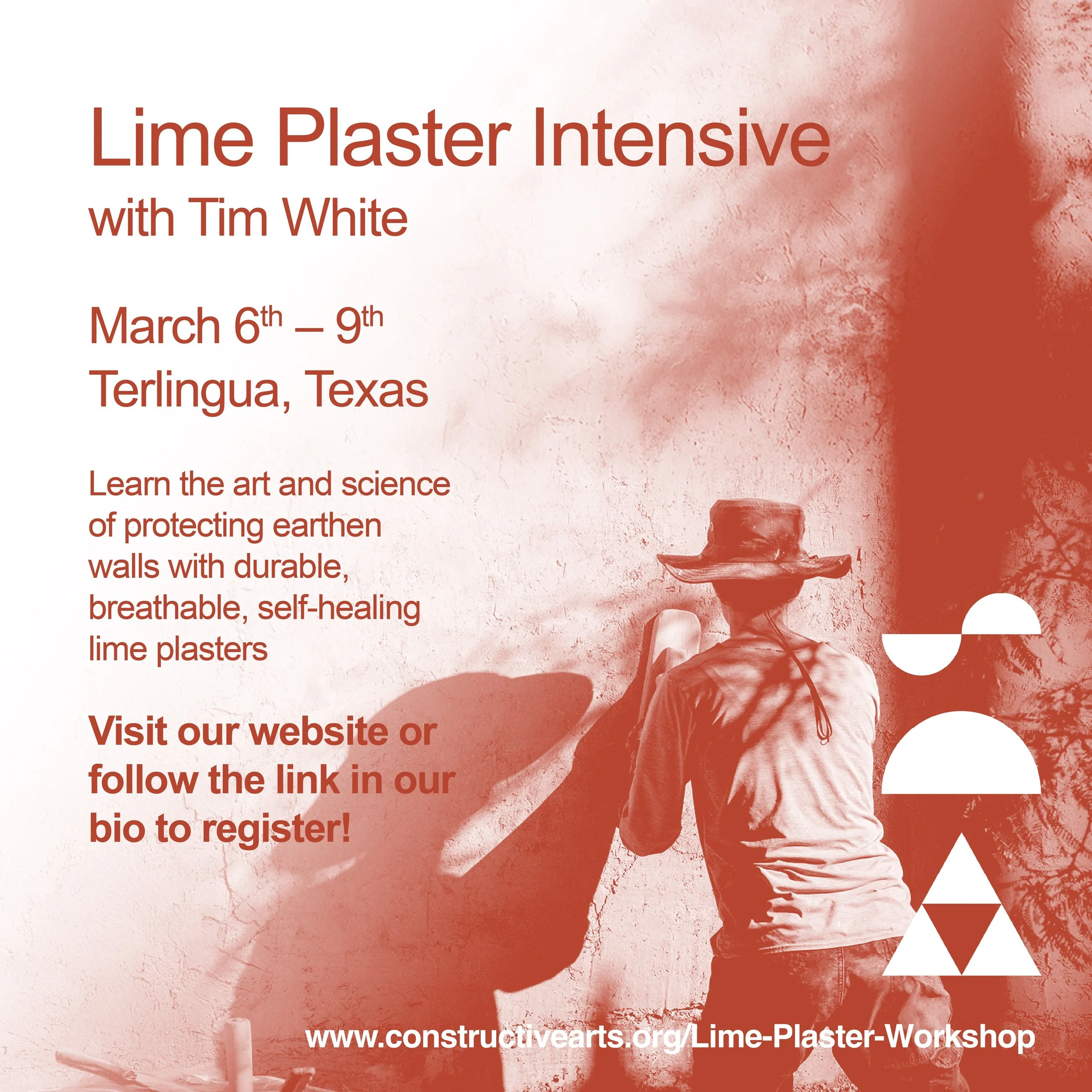
Veteran natural builder Tim White will join us to teach a 4 day intensive workshop on exterior lime plasters tailored to construction professionals who aim to master the enduring craft of working with lime. Lime plaster is an ideal exterior finish for earthen buildings. While cement stucco traps moisture and exterior clay plasters require frequent maintenance, a well applied lime plaster is both breathable and extremely durable. Tim's lime plaster method, derived from decades of experimentation and deep research into historical techniques, builds up a robust, breathable, self-healing skin of limestone that can protect a building for decades. Tim will explain the details of the lime cycle, microvoids and watervoids, pozzolans, sand gradation, bulking sand, balanced mix design, and application. Students will learn how to make their own mixes, apply plaster with a hawk and trowel, how to wood float lime plaster and when to do so, and how to make and apply a limewash to make lime plaster self-healing.
COST: $772.73
Tim White has been an industry leader in sustainable building materials for decades. His research into roman cement formulation and lime pozzolan interactions combined with decades of experimentation with natural wall systems and historic lime plasters, make Tim one of the few people with both the technical understanding and practical experience to teach a workshop of this depth. Tim worked with American Clay and Mason Greenstar and founded Texas Healthy Homes, a pioneering design-build firm specializing in hempcrete and natural materials. His accomplishments include developing educational programs, achievements in research & development, and recognition from esteemed institutions such as the US Hemp Building Association. We are honored to have the opportunity to learn from Tim, and look forward to welcoming him to SCA this Spring where we will work together to apply these techniques to the exterior of our new library.
At the School of Constructive Arts we combine hands-on education with detailed instruction to empower people to build resilient homes and communities that are healthy for people and the environment. Our goal is to offer robust classroom education in parallel to hands-on experience in a range of construction methodologies. In addition to the expertise shared by Tim, we may informally cover compressed earth block construction and other regenerative design topics. Take your education off-line and off-grid. Learn the ancient art and cutting edge science of building with the earth.
Key Learning Takeaways
Understand the Lime Cycle: An in-depth exploration of lime’s journey from raw mineral to building marvel.
Sand Graduation and Bulking: Learn how to achieve the perfect sand gradation and understand bulking for the ultimate mix.
Balanced Mixes and Void Dynamics: Delve into what makes a balanced lime plaster mix and the importance of water/micro voids.
Historic Masonry Self-Healing Plasters: Gain insight into how this underrated building material has been fortifying structures for centuries.
Day 1 - Friday - March 6th:
We will start learning ‘The Lime Cycle’ and basic material testing. We'll learn about proper sand gradation for your lime mortar/plaster and how to bulk sand. Then we will learn to create the proper mix ratio. Once we have our mix ratio, we will mix and start to apply the scratch coat. We will finish the day with an evening presentation on ‘Improper use of conventional mortar over historic materials’.
Day 2 - Saturday - March 7th:
We will get more practice mixing the first (scratch) coat of lime plaster. After all the walls have a scratch coat and have been raked, we will start to apply and wood float the brown coat to increase the strength of the plaster. Throughout Day 2 we will continue to gain experience using a hawk and trowel. This can be intimidating for beginners, but don’t worry, instructors will work with you and before the end of the week you will leave with confidence. We will finish the day with an evening presentation on “Historic Lime Plasters”
Day 3 - Sunday - March 8th:
We will continue refining our hawk and trowel techniques and make flat walls using a wood float. Then we will be applying a finish coat over a brown coat, and learn when to sponge the walls to achieve a smooth open surface that is ready to accept a limewash.
Day 4 - Monday - March 9th:
We will be learning all about limewash- how to mix, apply and add pigment to create a colored limewash. We will go over questions on historic lime plasters.